Thursday, November 29, 2012

Personal Expressionism


                     The artists depicted here are known, in my personal opinion, to be one of the most well respected and create women who defy something I like to call "personal expressionism".  I believe it goes beyond feeling and expressing art into a canvas, it goes into personal emotions and what message you are trying to make the audience understand. Not to only understand their art as an art form, but to question why they expressed it in this way. Since these are women who are very confident of who they are and how discriminatory the opposite sex can be (in every point in time), they will also make you question the gender roles, then and/or now, and how society runs on superiority of one over the other.

Artemisia Gentileschi (1593 - 1652/1653)
Italy

"Daughter of well-known Roman artist, Orazio Gentileschi (1563 - 1639), was one of the first women artists to achieve recognition in the male-dominated world of post-Renaissance art. In an era when female artists were limited to portrait painting and imitative poses, she was the first woman to paint major historical and religious scenarios."(Brash) She expressed her art form based, not solely but, on her own emotions and opinions of the gender roles. She was sexually assaulted by Agostino Tassi (friend of her father) and broke his promise to marry her (this would erase the crime), she expressed herself into the canvas the way she felt about men and societies view of women. She allowed her emotions to express her art form that many art historians don't seem to be impressed by. 

                 Self Portrait, 1960s

Frida Khalo (July 6, 1907- July 13, 1954)
Mexico

She was the most self expressive, personally expressive person artist of her time (and probably throughout history in general). Her art form was very surreal and altered the perspective of herself within the canvas through objects and placement of herself. This may be misleading to others, but she drew in this matter because she felt challenged by life itself and how it can take it's toll on the human body and sprit. She often showed signs of pain and suffering, very few in plain environments. She wasn't afraid of pushing the limits of human perception and wanted to express her way of understanding the pain she went through(complicated relationship with Diego, accident that left her paralyzed).


              The Broken Column 1944

Barbara Kruger (January 26, 1945- )
Newark, New Jersey

Now this artist is still active in the art world, but her take is on more of the Graphic Design world (my favorite GD artist). Her most famous art form is the black and white copies of images taken from pop culture of her time(1980's) and placing white lettering with altering fonts and red background on top of the images and the type would question and/or contradict what the image originally portrayed. It pushed the limits of current societal norms and put her own opinons of women's role in society. She expressed herself to the fullest and to manage to expand her career as a female artist astounds me.

                                 Not stupid enough, 1997

Marina Abramovic (November 30, 1946- )
Serbia

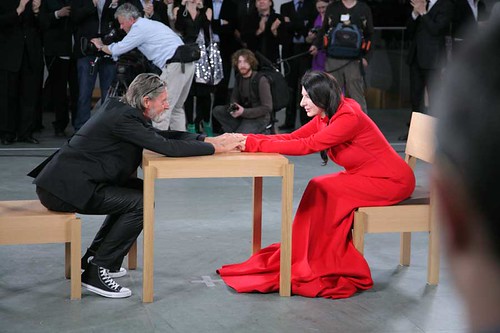
She is well known to express her art by using her body as a canvas. She used her body because she wanted to know the limitations of her own body, mind and spirit. The ability to stay still and stare at someone for hours at a time like she did in her exhibition The Artist is Present, it pushed people to understand her without having any dialog. Through herself she is able to express her personal resolve to make people understand who she is as an artist without a separate 
medium like the typical canvas. 

               Film Poster

Sally Mann (May 1, 1951- )
Lexington, Virginia
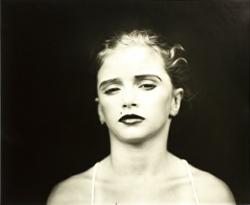
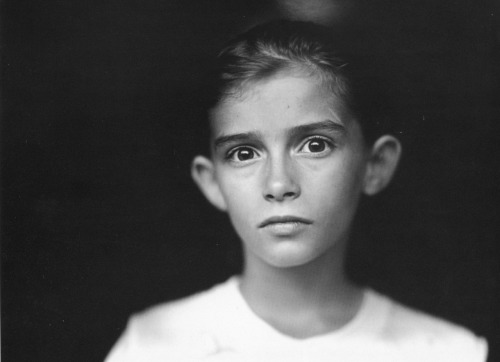
She started her career through photographs of nature in it's purest form. Her subjects changed and added her daughters and family into her work to symbolize how people are part of nature and aren't separate, despite our need to live and depend on modern technology and our perception of superiority (above the world). Maybe it's just these two images that i get this from but, i see her way of expressing her opinions similar to Barbara Kruger in the way she questions the roles of women through the simple process of adding and element and removing it. Her photography was astonishing to see in person (Newark Museum). Seeing both of these images separately without seeing the other has some little meaning, but together it creates something more. It shows how we should perceive our youth(Jessie as Jessie) and how we shouldn't expect them to (Jessie as Madonna). 

Jessie as Jessie
Jessie as Madonna

Sources:

Chadwick, Whitney. Women, Art, and Society. 4th ed. New York, NY: Thames and Hudson, 1990. Print.


Brash, Larry. "The Life and Art of Artemisia Gentileschi." The Life and Art of Artemisia Gentileschi. N.p., 1990. Web. 29 Nov. 2012. <http://www.artemisia-gentileschi.com/index.shtml>.
http://marinafilm.com/
Google Images

Five 20th Century Women Artists

Since the beginning of time in art there have always been excellent women artists even if they were not recognized in early times. It's difficult to choose which women artists stand out the most, but it was narrowed down to 20th century artists for me. Seeing some work by Dorothea Lange in "In Her Eyes: Women Behind and in Front of the Camera" Exhibition in Newark museum,  and works in class by Georgia O'Keeffe, Louise Bourgeois, Frida Kahlo, and Mary Cassat made me interested in this time period. These women were revolutionizing art for women by opening doors for other women painters. They were doing the same work as a "man's work" but expressing their oppositions against the stereotypical roles of women . Women's bodies and their nudity was no longer the only focus in paintings when these women started coming into the art world. 

A very famous painter of the 20th century was Frida Kahlo  who was born in Coyoacán, Mexico City in 1907. She was of German and Spanish decent but chose not to focus as much on her European side of her. At the young age of eighteen, she got into a horrible car accident which ended up leaving her handicapped. She immediately turned this situation into something positive and started to paint. Instead of letting this come in her way, she used this to fuel her desire for art and fulfill her ambitions. In one work of art called, "Without Hope", painted in 1945 by Kahlo, we see a part of her life struggle. She is laying in bed and being forced fed. Because in real life she had a special diet due to her accident which most people did not need. She wanted to emphasize the tough times she had to go through and portray a different subject than a man probably would. Her arms are pinned down, giving the sense that she has no control, no power, and no hope as the title says. 

                                                                 Without Hope, 1945

Another famous woman of that time was Mary Cassat, born in 1844 in the U.S. Cassatt frequently made images that reflected the private lives of women which no one was bold enough to show yet. She also commonly had an emphasis on the special bond between mothers and children and put those in her work.  It was a known fact that Mary Cassat had obtained all her artistic abilities from her mother, Katherine Cassat. She was also exposed to a lot of art when she was in France where she stayed for a majority of her life. A very famous painting of hers which has her mother-child relationship shown is "Breakfast in Bed". Painted in 1897, Cassatt shows a very calm but moving scene in which a mother is embracing her daughter who is obviously intrigued by something else elsewhere. The contrast she shows with the mother's protective gaze and hug with her daughter's curiosity with whatever else is out there shows the subtle tensions between the mother daughter relationship and focuses on the nature of women rather than their bodies. 

                                                               Breakfast in Bed, 1897
           
Dorothea Lange was a very notable female artist from Hoboken, New Jersey. She was always quite successful, beginning with her education at Columbia University to opening her own portrait studio in San Francisco. Instead of painting and using a paintbrush, Lange used her camera. She took her camera to the real world when the Great Depression hit the U.S. She took a picture of the very famous "Migrant Mother" in 1936. It is one of many of series of pictures of Florence Owens Thompson and her kids during the depression. The photograph shows so much misery of the poor women who is only 32 but looks so much older due to stress. Lange greatly captured the struggles of women and showed they have to deal with so many more issues than just looks. Lange highly influenced the creation of a concept called "Documentary photography". She took several pictures in chronological order to show a series of events just through the pictures. 


                                                                Migrant Mother, 1936 

A well-known French artist in this time also was Louise Bourgeois born in 1911 and died recently in 2010. Her best known style was modern and contemporary and she was also known for being the founder of confessional art. The most celebrated sculpture by her was the "Maman" which depicts a giant spider (30 feet high and 33 feet wide). The spider was an ode to her mother because like spiders, her mother was a weaver as well. Also she was a clever and protective figure to her. She explained that spiders ate mosquitoes to protect us from disease as her mother used to protect her. Her odd way of representing her mom is unique since most people consider spiders vicious, ugly creatures.


Maman, 1999

One last woman artist of the 20th century is Georgia O'Keeffe, born in 1887. She often displayed emotion and power of objects that exist in nature. Several of her paintings include bones, flowers, and landscapes around New York and New Mexico. Her paintings also appeared as if one was looking through a magnifying glass and it was an enlarged photo. In this video we can see O'Keeffe discussing her work and her perspective on her own work. All of these women artists from the 20th century clearly show different topics they focus on and how they see art as opposed from the male point of view. 

Works Cited:
"Louise Bourgeois. Maman: From the Outside In." Art & Education. N.p., n.d. Web. 29 Nov. 2012. <http://www.artandeducation.net/paper/louise-bourgeois-maman-from-the-outside-in/>.
"Georgia O'Keeffe Biography." Georgia O'Keeffe Biography. N.p., n.d. Web. 29 Nov. 2012. <http://www.lkwdpl.org/wihohio/okee-geo.htm>.
"Frida Kahlo." - Paintings, Biography, and Quotes of. N.p., n.d. Web. 29 Nov. 2012. <http://www.fridakahlo.org/>.
"Cassatt, Mary." WebMuseum:. N.p., n.d. Web. 29 Nov. 2012. <http://www.ibiblio.org/wm/paint/auth/cassatt/>.

Five Female Artist Remove a Mask


In the exhibition "Angels and Tomboys" there was the depiction of girls throughout the centuries. Among these are parents depicting their daughters and in these depictions it is apparent the ideal characteristics. Many of the girls hold flowers, dolls, and pets that link to ideas of how girls should be and act. The flowers show how delicate and beautiful girls were expected to be; connected to nature and displayed like the flowers many of them are holding. The dolls and pets are training tools to make these girls good mothers; caring and submissive to both their children and husbands. 

The five female artist go against this image of submissive domesticity. There work shows women existing outside the ideal, not as failures but as they are without labels or pressures of society. They show reality rather than a posed image of "perfection". 


Ana Mendieta 
Her work exist temporary and when will change just as nature changes. This speaks out at looking at women like flowers. When someone looks at a woman as a flower they see her as something that is to be looked at for beauty. They see her as an object to be looked at temporary because just as a flower she will get old and undesirable and will eventually be thrown out and a new fresh one will take her place. In painting her the artist has captured her beauty and so she will live forever in the painting as a fresh new flower that is desirable. Contrasting this idea Mendieta has craved the dirt which is something that people do not paint. She has made the siluette of her body in the dirt. Her work does not intend to permanently capture and image and preserve it. The dirt will shift and change shape but the dirt itself stays the same. 

There is a level of ambiguity in her work that leaves a lot to the viewers interpretation. These pieces for example was made by using gun powder that was laid out and then set on fire. Fire causing a transformation. Fire something that destroys and yet in nature when it destroys something comes up from the ashes. New life is allowed to take hold where the old life once dominated. Her ritualistic approach can be connected to her Cuban background. She uses two elements, fire and earth, to show herself and to put forth her questions of identity. There is an absence although there is a presence. There is a cycle in her use of earth and fire; there is rebirth. 

Alice Barber Stephens
 "The Women in Business" Alice Barber Stephens 1897

"The Women's Life Class" Alice Barber Stephens 1879
 In "The Women in Business" Stephens shows inside a market place; a public space. The people immediately seen are all women, in fact the majority of the people in the room are women. Unlike many of the other depictions of women this one is made with a limited amount of color, there is not flower like colors that pop out. There are different classes of women engaging in business never is there interaction with any man. These women do not seem to be women of virtue or showing any of the same characteristics shown in other paintings showing motherhood, submission, or beauty. These women do not exist posing or waiting to be seen and none look towards a waiting audience.  This last is the same in "The Women's Life Class" where all the women are all unaware of the spectator and the single nude women has her back turned away to the viewer. In her work, Stephen's shows women existing just as they are which does not require interaction or attention from men


Naomi Savage 
Naomi Savage 
What I found interesting about looking at these pictures was that I was able to see my own reflection on the glass. Although I'm sure that this was not intentional and that the glass was meant to protect the images I found deeper meaning in being able to see my own reflection. In my own experience I was able to become part of these pieces. When looking into the one with the face of a women in different poses my face became part of the image. When looking at the mask I saw my own reflection in the mask. The one of the cut out images reminded me of a cookie cutter and the idea that not all of us come from the same mold although we may have our similarities. In the abstract of her photos there is a connection to the other four artist I have chosen. The mask is like the one Sally Mann uses below. She is covering up her face and yet we know that beneath it is the real woman. 
Naomi Savage
Naomi Savage


Sally Mann 
"Jessie as Jessie" Sally Mann 1990
"Jessie as Madonna" Sally Mann 1990

Looking at "Jessie as Madonna" and "Jessie as Jessie" it is hard to tell at first glance that both are images of the same girl. At the Newark Museum they are placed next to the same door on either sides. In "Jessie as Jessie" she looks as an androgynous figure, gender is hard to tell because of her youthful face that gives not hint. But in "Jessie as Madonna" it is obvious that this same person has been transformed into a girl. But not just any girl; Mann has turned the androgynous into a celebrity with the use of makeup. Mendieta used fire as her tool of transformation and Mann uses makeup as hers. The makeup becomes almost like a mask. The mask covers up Jessie's innocence and youth and makes her into a sexual being. This is just like how our culture tends to take the image and put a mask on it making it something different. Behind the mask still exist reality. Mann uses a mask to unmask what our culture does to girls. Hiding reality and making them into something they are not. 


Helen M Stummer
“Arnetha as aChild While Living in Newark” Helen M. Stummer
 “Goddea,Tea Time on Good Friday" Helen M. Stummer
 Helen M Stummer does not go outside her community to find the perfect spot to photograph or look for beautiful things to capture. Instead she looks where many people turn their heads from. Her work is of the impoverished people living in different areas like here in Newark, NJ. Her subjects are not posed waiting on the flash; she chooses to take photos of people just as they are without manipulation. In "Aretha as a Child While Living in Newark" there is a girl fixing herself in the mirror, no doubt she is copying what she has seen adults doing. She is absorbed in her action and it seems to distract her from reality. In "Goddea, Tea Time on Good Friday" once again there is a girl absorbed at the task in hand. This reminds me of the Japanese tea ceremony in which the participates and the host are to block out any of their problems, the past and future, and concentrate on that very moment. There are flowers in the picture. The girls does exactly what society is telling her to do, she is fixing her hair and playing games that mimic the task she will be doing in the future as a wife and mother. But what Stummer does that is different from those depictions is that she shows how these girls who live in a different situation that those of many of the painting live with the same ideas. Doesn't it seem a little ridiculous? Their lives are different but their roles are the same; poverty does not change expectation it seems like her child play is hopeless and does not help change her situation. 


The Representation of Strong Women Throughout Art History

     Artemesia Gentileschi was daughter of Orazio Gentileschi, an italian painter. Her style of painting was more like Caravaggio's. She worked with her father at his workshop, and proved to be the best painter out of all his [male] children. Her father hired a man to mentor her, and as well know, she was raped. Back then men could rape a woman and promise to marry her in order to not make her "look bad" because he had taken her virginity. Although he was taken to court for raping Artemesia and he had been proven guilty, he never served time for the crime he committed. In the painting to the right, Judith Slaying Holofernes (1612), Judith and her maidservant are beheading Holofernes. This painting is very bloody, graphic, and violent. You see blood every where spurting out in different directions, and the women do not look frightened at all. Artemesia uses the painting to show all the anger she has and what her rapist deserves; she is Judith and her mentor is Holofernes. Artemesia uses this painting that lives on forever, to send a direct message to her rapist. She's not afraid of him, and she wants him to know it. She also worked alongside many men, and never let people putting her down for being a woman (or being accused of having her father help her with her paintings) stop her from painting. 


Another strong woman in the Renaissance period, Elisabetta Sirani was the daughter of the painter Giovanni Sirani. Being a woman of course, she could not keep her earnings, so she had to give all the earnings to her father. Though, when her father became incapacitated, she had to support her whole family with the money from her paintings. Many people did not think that she did her paintings, so she painted publicly for everyone to see that she had great talent, and that a woman can draw just as good or even better than a man. One of her most recognized paintings was Portia Wounding Her Thigh (1664). In this painting, "Portia has to prove herself virtuous and worthy of political trust by separating herself from the rest of her sex" (Chadwick, pg. 101). She is pushed into the foreground and is stabbing her knee to prove that she is strong, courageous, and different; the women in the background are trying to please the man, what was expected of women. Sirani shows that women can be as brave as men as well as showing no sign of pain or disgust.


     Many people believed that women could not be as good painters as men, let alone sculptors. People believed sculpting was "beyond a woman's capabilities". Harriet Hosmer was an American, lesbian sculptor. She had a contemporary neoclassical style. Harriet Hosmer moved to Europe in 1852 to expand her career and find a place more tolerant for an independent, lesbian woman. She sculpted Zenobia in Chains (1859). Zenobia was a third century queen of Palmyra, who defeated and was captured by the Romans. People told stories about being a classical woman who was abducted. Hosmer, instead of telling the story, created this statue to show that the queen didn’t succumb to her capture and humiliation; she stood up for herself. She draws Zenobia strong and confident.  This emphasized feminism in the 19th century by pointing out her intellectual and emotional strength in the face of hardship. Hosmer painted Zenobia strong, like she was, for being openly gay in the 19th century. It still was not very much accepted, yet she would end up in a relationship and happy. 


     Lily Martin Spencer became the most popular and widely reproduced female genre painter of the mid 19th century. She supported thirteen children with her artwork/paintings. She lived in role reversed home. Her husband took care of her children while she brought the money to put food on the table. Now, there are very rare occasions where we see this happening. Women were still not very accepted in the art world, yet here there was a woman, who took the role of the patriarch in the household. She painted domestic scenes in which women and children were happy. Although she did have an audience for her work, Lily Martin Spencer had difficulties making a living from being a painter and was always struggling financially. Her art was placed as decorations in homes. The painting on the right is Kiss me and You'll kiss the 'Lasses (1856). The woman in the painting is smiling at the viewer, but as the title suggests, if the viewer tries to kiss her, she will hit him with the spoon she has in her hand. Although quite comical, it's interesting how she paints the woman in the kitchen getting things ready, while in her household she was not the one who had to cook, rather her husband, and she was stuck providing enough income for her children, herself, and her husband. 


           Last, but definitely not least, we have Marina Abramovic, the grandmother of performance art. For her artwork, she uses her body as her medium. She "explores the  relationship between performer and audience, the limits of the body, and the possibilities of the mind". She's strong and proves it in her art work.  She has many exhibits, but the most interesting is "Sitting with Marina". She sits down for hours (a total of 750) upon hours, and challenges people to sit in front of her. Often, many cry because they cannot handle it. Abramovic has to train herself not only to sit down for so many hours, but discipline her mind to concentrate for so long. Some last minutes while others last hours. It's a mental game where she's unstoppable, and you can't beat her gaze. 

Works Cited
Chadwick, Whitney. Art, Women, and Society. New York, NY. 4th edition. 1990. Print.
Lily Martin Spencer http://www.nmwa.org/explore/artist-profiles/lilly-martin-spencer
"The Art is Present" http://www.moma.org/visit/calendar/exhibitions/965


Five Women from the 19th Century

  The 19th Century was an extremely interesting time in history. There was a growth in middle class, many new technologies were allowing a growth in class which caused many social and economical changes.  During our visit to Newark Museum to see the Angels and Tomboys Exhibit some of these women artist had there artwork in display while others did not. The following women artist, were artist which were influenced and were experiencing the economical growth and change during this time. Lilly Martin Spencer, Cecilia Beaux, Ellen Kendall Baker, Rosa Bonheur, and Edmonia Lewis. They all were so influenced by this time period and so much of it can be seen in the work they made. 
    During our visit to the Newark Museum, I had the pleasure of seeing Lilly Martin Spencer work in person. It was simply amazing, the detail and the message the art work showed was one which can not be put into words.  Lilly Martin Spencers known for her satirical paintings, and as we saw the exhibit in the Newark Museum we were able to see the satire in the paintings. As we learned in the Newark Museum, Spencer was also instrumental in popularizing girlhood imagery in the mid 19th century, which was when these themes became increasingly accepted in American art. Her lithographs were mass produced and distributed to an expanding middle class hungry for inexpensive prints with accessible subjects that could be used for home decoration.

  We also know that Spencer in most of her works created domestic narratives in which women and girls are the primary actors, like in the images we saw "War Spirit at Home (Celebrating the Victory at Vicksburg), and "The Home of the Red, White, and Blue". These paintings were created right after the Civil War. In the War Spirit at Home we learned, Spencer is expressing how the Civil War affected there homes, and how the women were extremely overwhelmed and not taking control of the children. 
  In the painting "The Home of the Red, White and Blue" seen below. It shows the mother as the matriarch power, next to the torn flag is a sewing box which insinuates the women and daughters will restore it and put the pieces back together for the nation. As we learned in the Newark Museum the message Lilly Spencer is stating is the mothers and daughters are the bedrock of social stability and harmony.
Height of Fashion
  One of Lilly Spencer lithographs is shown here. The painting titled "Height of Fashion"which is seen above, shows an African American girl with a pet dog, fake monocle and finger extended pretends to be fashionable. The artist poked fun at the pretentiousness of the child trappings and mannerisms associated with high society. 
  Lilly Spencer is one of my favorite artist during this time, her humor and her stories she tells through her paintings are something I could never get tired of. She made women the main focus of her paintings but she did not use nude she used intellectual, strong women. Which indeed women are.
Portrait of Harold and Mildred Colton

      The second artist paintings we were able to see were Cecilia Beaux, her painting is different and similar to Lilly Spencer. Different because this image involves children but similar because she made the female child just as strong as the male child. As we learned in the Newark Museum what is unique about this paintings is the forceful personalities both children are portraying, making the children appear as equals which during this time period was rare. According to the Newark Museum the way the children are being portrayed is because Beaux, as woman, was disinclined to marginalize her female sitter. However, she did use traditional objects which to distinguish each child with, the boy with the whip, and the girl with the fruit. 
Dorothea in the Woods


 In the Painting "Dorothea in the Woods" Beaux  (as stated in the newark museum) "captures the introspection, developing sexuality and self absorption of the teenage years. The young ladies moody, withdrawn and guarded expression shows her complexity. Surrounded by flowers and plants shows her growth as a young lady. We also learned that at the end of the 19th Century Beaux along with other artist created a new, feminine type in their powerful of adolescent girls. 
    

Ellen Kendall Baker was known for her paintings of children, during this time as we learned in the museum many women artist often excelled with childhood images, subjects that they were encouraged to produce in the male- dominated art world during the 19th century. 
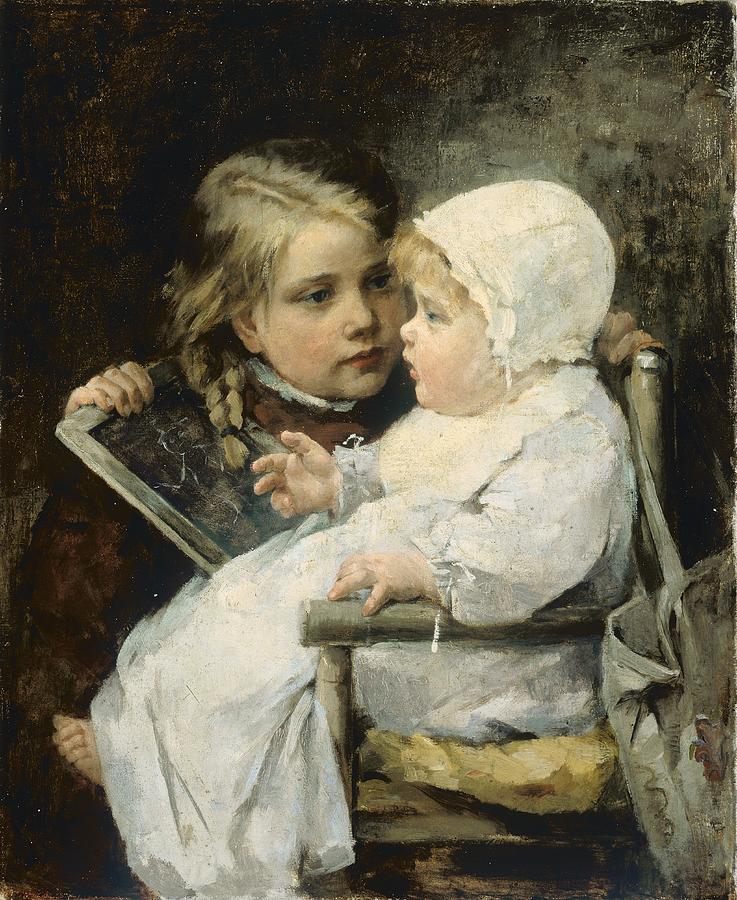
The Young Artist
 The painting seen to the right titled "The Young Artist" is a scene of a young girl acting as an art instructor to her sibling. She is holding a stick and drawing on a slate and stares at the baby. The way they are close and there heads are close to one another shows that they are emotionally and physically connected.

The next artist I was not able to see the wonderful talent in person but they were two women that stood out to me in our readings. Rosa Bonheur and Edmonia Lewis were women whom really took a stand with there artistry during this time. 
  Let me start with Rosa Bonheur, a woman definitely ahead of her time, she was interested in women and animals. She was one of the most successful artist of her lifetime.  She would take any risk necessary to be able to paint things she loved, she was able to paint many things other women could not because she at times dressed and impersonated men. Rosa was fortunate because as her father was a director of an art school she was able to learn and perfect her art. 
         One of the paintings I admire the most by Bonheur is titled "The Horse Fair" which is seen below. The horse fair sends a message so loud and clear.  Guerilla Girls stated this was a painting that made her "one of the best loved artist in Europe." This painting was one in which Bonheur dressed as a male, to not attract attention form the horse dealers, see link
This paintings expresses the time and how many women were property to the men they married or the fathers whom raised them. The taming of women is the message the painting is portraying. Rosa Bonheur had many paintings with animals, by painting animals she assumed the role of a male painter, and it gave her power to paint from war images, to bulls, to horses, she painted what she loved and had nothing holding her back.
    Edmonia Lewis different from much of these women but all within the same time frame is another female that is my favorite from this time. Her medium was sculptor. Different from the other artist of this time, however, her message was just as powerful, she addressed human rights, emancipation. She went to Italy to sculpt about the political matters in the U.S. Forever Free is one sculptor that addresses emancipation proclamation it shows a women kneeling next to a man that has his hand up in happiness and shows his broken chains. This was the beginning of neoclassicism which is inspired by Rome.
   In conclusion, not all these women where in display at the Newark Museum, however, the theme I choose to focus on was 19th century female artist. This time was a very important time for change. It was the newly formed USA, we went from a time of women belonging to the home to women traveling, women dressing as men, women sculpting about freedom.


References


Chadwick, Whitney. Women, Art, and Society. 3rd Edition. United Kingdom: Thames and Hudson Ltd., 1990.
 
Girls, Guerrilla. The Guerrilla Girls' Bedside Companion To The History of Western Art. England: Penguin Books., 1998 
http://americanart.si.edu/exhibitions/online/lewis/lewisbio2.html
http://www.metmuseum.org/toah/works-of-art/87.25
http://www.flickr.com/photos/gandalfsgallery/5633637931/
http://www.dia.org/object-info/50dd5a1a-e063-4f9c-9d4b-0b7475b8d0db.aspx?position=130


5 Unique Women Artists


The 19th and 20th century brought out many unique and special female artists.  The more female artists came about, the more popular they became.  It was no longer about the men, the women were getting themselves noticed in the art by society as well.  Some of the women artists we have discussed in class that interested me are Frida Kahlo, Barbra Kruger, Judy Chicago, Georgia O’Keeffe, and Marina Abramovic.

Frida Kahlo Photo
Frida Kahlo
Frida Kahlo has become the most admired female Mexican artist almost five decades after her death.  She used her body as a symbol for her artwork.  She showed the pain and heartache she suffered in her paintings.  She specialized in self-portraits and telling the story of her life in her work.  Her art is sends a powerful and endearing message to the viewers.  She did a very good job on getting herself noticed in her society, especially over her husband, Diego.  ``The world just loves women artists who are sad and dead.  But I was the hero of my own life.’’(Kahlo)  She also worked on other themes such as portraits for friends on commission, still life’s, and cosmic panoramas.   Frida was a very influential figure in the 20th century art world. 

Barbara Kruger, born January 26, 1945, in Newark New Jersey.  She is an American conceptual artist.  She attended Syracuse University for a year and then moved to NY to attend Parsons School of Design.    Barbara began to employ images in her art with words or captions directly over them.  Her captions on these images were mostly her view on sex, religion, racial and gender stereotypes, and power.  Her work has been shown off in galleries, museums, buildings, train stations, parks, and even ceiling walls.  She tried to reach out to her viewers and make them think about what she is trying to say.  ``I had to figure out how to bring the world into my work.’’ (Barbara Kruger)

Judy Chicago ‘s art piece, The Dinner Party was very interesting and unique.  This was set up to honor the history of women in Western Civilization.  There were over 999 important women and their names were grouped around the place settings to symbolize the traditions of women's achievements.  Each set was shaped identical to a woman's vagina.  This symbolized how women were overtaking the men in society and becoming well known.  This was exhibited in 16 venues in 6 countries to an audience of over one million. 

The Dinner Party
 For decades, Georgia O'Keeffe was a huge figure in American art.  She was the first woman to get a retrospective at the Museum of Modern Art.  She painted a series of architectural pictures that depicted the soaring skyscrapers of NYC.  Most often though, she painted landscapes of close-up flowers from her trips to her summer home in Lake George.  The last twenty years of her life she was very ill and this decreased her ability to do art.  When she died her ashes were scattered over the New Mexico landscape she had loved.  
White Flower on Red Earth 1943

 Marina Abramovic  was born in 1946 in Belgrade Yugoslavia.  She began her career in the 1970s, and her body has always been her subject and her medium.  She explores her physical and mental limits of herself.  She has presented her work with performances, sound, photography, video,  and sculpture.   One of her work in the exhibition that I found interesting is called The Artist Is Present.  People go and sit in front of her taking turns staring at her, seeing how long they can go.  It is all about how far you can exert yourself until you cant go anymore.  Some people sit there for hours staring at her.
The Artist Is Present
 Work Cited
"Barbara Kruger - Feminist Artist - The Art History Archive." Barbara Kruger - Feminist Artist - The Art History Archive. N.p., n.d. Web. 29 Nov. 2012. <http://www.arthistoryarchive.com/arthistory/feminist/Barbara-Kruger.html>.
 The Guerrilla Girls. The Guerrilla Girls' Bedside Companion to the History of Western Art. New York: Penguin, 1998
 http://www.fridakahlo.org/
 http://marinafilm.com/about-marina-abramovic
 http://www.metmuseum.org/toah/hd/geok/hd_geok.htm
http://thismamamakesstuff.com/2011/03/art-smart-a-lesson-in-okeefe-art-critique-pastels/georgia-o-keeffe-white-flower-on-red-earth/
http://www.judychicago.com/gallery.php?name=The+Dinner+Party+Gallery

Post 4- Gender roles


Throughout the course of this semester we have been discussing various topics when it comes to women artists and women in the art world but an overall theme that these topics share would be the “ideal woman.” How women are supposed to act, how they are suppose to appear within the male gaze and what women are supposed to portray such as innocence and purity. Determining their gender role is an important matter and is highly looked upon. The role of women and the need to express, change or even destroy their femininity is comes into play for both artist and women captured within the art itself. 

The photography exhibition "In her eyes" The sitters who posed for these photgraphs, did so dressed up partially exposed or completely covered. Some altered their appearance by emphasizing their femininity or by cross-dressing. Others are depicted in their day-to-day reality. "Angels and Tomboys" 


Richmond, Californina, 1942
Gelatin silver enlargement print on cardstock
"Dorothea Lange, worked in Richmond California, documenting the major socio-economic shifts that were occurring as a result of the booming shipyard industry during the 1920-40s" (Newark Musuem). During this time there was a high demand for women to enter the working field. However they were not allowed to distinguish themselves from their male counterparts and thus having to hide away their femininity. "Women were required to wear masculine clothes so as to not distract their male co-workers. The functional purpose of the woman's overalls, however, also alters her identity making her appear genderless" (Newark Museum). We see in Dorothea's photography, Richmond, California that although she blends in with the masculine crowd there are still a few minor details that would allow the spectator to see that she is still a woman; such as her hair peeking out from underneath the hat and the flower coming out of the bag. These small symbols are unique because in history they have been known to be feminine and thus the person accompanied by these symbols is in fact a woman. Dorothea does a good job depicting the gender roles of women, although women were allowed to work, they dressed like men because the working world is a man's world. 


Harold and Mildred Colton
1887, oil on canvas 
Another artists that helps us determine gender roles among women in society would be Cecilia Beaux. She painted a lot of scenes of the 19th century, a time when determining whether or not an infant in a painting was male or female was a hot topic. Like most of the male artists featured in the exhibition of Angels and Tomboys, Cecilia paints a portrait of Harold and Mildred Colton. These painting in reticular is easier to determine gender roles because of the symbols within the painting. First, the way that the children are dressed, one in a dress and another in pants. However, the most important symbols present would be the whip and the apple that the children are holding. The whip is a symbol or masculinity, it means power and dominance, whereas the apple is a symbol or purity and innocence, commonly used to describe women (Newark Museum). We also see the gaze that both children are giving the spectator, the little boy has a powerful gaze staring directly at the viewer, whereas the little girl is looking but from  the corner of her face. This subtle actions tell us how men and women were looked at in the 19th century and the "image" they were to obtain. 
Speak Lord (portrait Minnie Evans)

Nina Howell Starr worked along side with Minnie Evans, in one of her photographs of her "Evan's veiled eyes and open hand gestures, as though praying, her identity is concealed and she appears to become a spiritual and mysterious figure" (Newark Museum). This is important because of the role that women played when it came to religion. We have learned that in the middle ages women did not have a lot of freedom, however religion was always available to them. The roles of women allowed them to join the clergy as nuns. Therefore, this photograph not only shows the purpose of religion and gender roles but it also shows us the ability to hide away one's feminine aspects just like in Dorothea's photography. 


War Spirit at home.
Oil on Canvas. 
Lily Martin Spencer is very famous because she shows us how women take on the role of men. In a world were women's gender roles were important; the idea of a stay at home house wife seemed like the ideal woman. However Lily likes to make paintings where women are breaking away from traditions, they are breaking the chains of their femininity and joining alongside their male counterparts. In her painting of war spirit, she shows us how women are no longer following the norms of society and instead are taking bigger responsiblities of being both the household provider and house wife. We see the women multitaking and learning to balance both their feminine and masculine traits.  


“Angels and Tomboys is the first exhibition to examine the diverse interpretations of girls in the 19th century paintings, sculptures, prints and photographs. Leading women artist Cecilia Beaux, Lily Martin Spencer and Bessie Potter Vonnoh focus on the complexity of girlhood. While the sentimental portrayal of girls as angelic, passive and domestic was the pervasive characterization, this project also identifies and investigates compelling and transgressive female images including tomboys, working children and adolescents” (Newark museum, Angels and Tomboys).

Ann Hall is another important artist that shows us gender roles within the exhibit of Angels and Tomboys. In her painting Louisa and Eliza Macardy” (1845) We see the there is a strong connection between a mother and her child. This is important because we see that her daughter relates to her mother, that one day she will also take on the motherly role in life. This painting shows us the passive daughter, the role of motherhood and the femininity of both people present in the painting because of they way they are dressed and presented to the viewer.

Overall, through these artists we are able to get a better understanding of the roles that women play in society and how important the idea of femininity and masculinity is within the art world.


"Angles & Tomboys: Girlhood in 19th-Century American Art.”  Newark Museum. 49 Washington Street, Newark, NJ 07102. 23 Nov. 2012.

“In Her Eyes: Women Behind and in Front of the Camera.” Newark Museum. 49 Washington Street, Newark, NJ 07102. 23 Nov. 2012.