Sunday, October 14, 2012

From the Medieval to the Industrial: Women's Role and Art in Society

POST 2

Alejandro Hincapie

            When examining the roles of women in European society, economic and cultural conditions largely dictated what areas of life women were designated to and what womanhood and femininity at large represented to the societies that put them there. Despite being subjugated by institutionalized and culturally constructed patriarchy, women were nonetheless still able to create art that commented on society at large and often on the way women themselves were treated.
            The Middle Ages found women circumscribed to strict roles dictated by the Christian church, the prevailing institution of authority in medieval life.  Women worked as either laborers performing arduous agricultural tasks under the feudal system that prevailed at the time or as merchants working in a business owned by a man—all in addition to their primary role as caregivers in the private sphere of life. However, as the Guerilla Girls state in their book The Guerilla Girls’ Bedside Companion to the History of Western Art, working women in the Middle ages were forced to concede that the “fruits of their labors belonged to men-their fathers, husbands, or brother” (Guerilla Girls 22).  But despite women seeing little economic and societal gain through their own work, the importance of women in the medieval economy as a means to facilitate labor and business did ensure them a place in guilds, despite restrictions on their admittance (Chadwick 63). In guilds, women worked alongside men practicing needlework, sculpture, masonry, carpentry, painting, and decorative arts. Because medieval artists did not sign their work with their own name but with the name of the work’s patron, dispute exists today over the gender of the creators of surviving works (Guerilla Girls 21).
            While guilds were one place in medieval life where women were able to produce art, monasteries provided women a place on a higher, elite class as the church was the dominant institution in medieval society.  Becoming nuns for different reasons such as their family having no money for a dowry or to reform after prostitution, women in monasteries were able to exercise their intellect and artistic abilities by becoming literate, making tapestries, copying illustrated manuscripts, writing books on topics from science to the arts, and composing and preforming music (Guerilla Girls 21, 22). Though prohibited from giving sermons, entering priesthood, and teaching those outside their monastery, nuns in the Middle Ages were afforded the right to dictate their mystical visions of their encounters with God to scribes and to artists to have them illustrated (Guerilla Girls 22). These works traveled all over, spreading these women’s visions of the truths and nature of Christian faith and giving them an important voice within the church (Guerilla Girls 22). However, nuns were seen merely as the vessels of these mystical and spiritual visions and once these women began to warn against sin and corruption within the religious establishment, the church quickly silenced them. Indeed, once Hildegard von Binge’s, one of the most noteworthy nuns and head abbess, views became increasingly independent towards the end of her life, she was placed under house arrest (Guerilla Girls 25).
            Arguably, moving forward into the Renaissance, women found their role and importance in society diminished. As Chadwick explains in Women, Art, and Society, societal and economic developments that were ushered in with the Renaissance, particularly “the consolidation of the state and the development of capitalism, adversely affected women by leaving them with less actual power than they had enjoyed under feudalism” (Chadwick 66). Indeed, in Renaissance Italy, women were prohibited from participating in governmental patronage and had no role in commissions carried out by guilds (Chadwick 67). In guilds, unskilled activities were relegated to women as the idea of individual, distinguished artists began to take hold in cultural and artistic production (Chadwick 69). Generally, women were afforded little to no role to play in what Chadwick explains was a “cultural renaissance oriented toward the growth and embellishment of the city as a matter of civic pride” (Chadwick 70). However, in Renaissance centers of culture and economy such as Florence, women and their role in alliances through marriage came to represent honor, wealth, and social prestige (Chadwick 76). This emphasis on women as sources of pride for individual families coincided with the growing separation between the public and private spheres of life during the Renaissance.
            Despite all this, some female artists were able to gain recognition during the Renaissance, while still instilling their work with commentary about the societal conditions under which they worked.  For 16th century artist Sofinisba Anguissola, several conditions aligned to help her live as an artist and reach recognition. First, she came from a family of modest nobility whose father encouraged all his children, including girls, to develop their artistic skills (Chadwick 78). Anguissola’s place as a women prevented her from seeking mentorship for herself and consequently, it was her father who reached out to Michelangelo asking for his mentorship that she eventually received and allowed her to become the Spanish court’s in-house painter (Chadwick 79). Furthermore, Anguissola as a woman was prevented from examining live nudes and human anatomy—essential to composing the ideal, Classical forms in figures valued in Renaissance oil paintings (Chadwick 78). As a result, Anguissola’s work focused on portraiture and it is her self-portraits that reveal her awareness of her condition as a women artist. In them, she is acutely aware of her role as both a women and therefore and object of art (in one self-portrait, she depicts herself being painted by a male artist) and of the unique position she found herself in as a recognized female artist (she emphasizes her role as a painter in self-portraits). Anguissola’s position as a recognized female painter put her in a unique place that as Chadwick states, “removed her from competing for commissions with her male contemporaries and that affectively placed her within a critical category of her own” (Chadwick 79).
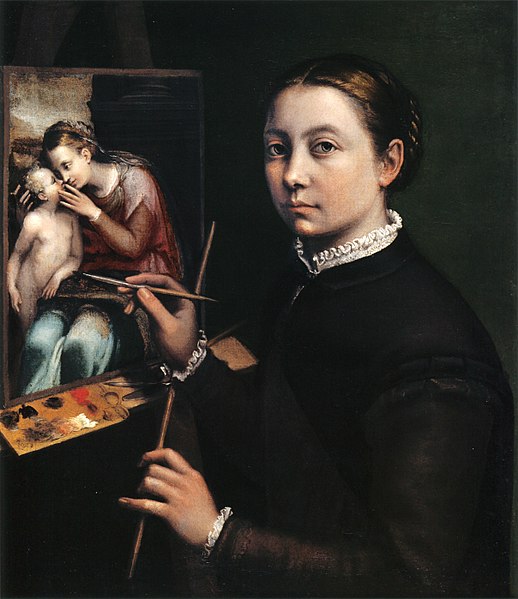
Sofonisba Anguissolla. Self-Portrait. 1556. Oil on Canvas. *
            The 17th and 18th centuries in Europe saw much wealth brought to the continent through the colonization of the Americas, Africa, and Asia and an expansive slave trade that facilitated vast amounts of cheap labor (Guerrilla Girls 39).  And while intellectual movements such as the Enlightenment took precedent across Europe and political and social revolutions swept the US and France, women still found themselves subjugated into having little roles to play outside the domestic, private sphere (Guerrilla Gils 39). Indeed, iconic philosophers like Rousseau maintained that woman’s place was at home being a caregiver as dictated by “nature” and by “reason” (Guerrilla Girls 39).  Indeed, a women’s virtue was acknowledged, but only if it came from her work as a housekeeper, strictly carrying out the expected role of all women.  
            This confinement of women to the private sphere in the 17th and 18th centuries caused female artists to focus largely on domestic themes – genre paintings, still lives, and portraiture—as they continued to be disallowed to paint history paintings and study nude human forms.  This also coincided with a growing class of wealthy merchants in Northern Europe who as patrons, wanted works that showed off their material possessions (Guerrilla Girls 39). Dutch female artists Rachel Ruysch, for example, found great success plaiting still lives of flowers – symbols of Dutch wealth and pride (Guerrilla Girls 43). While Anna Maria Sybilla Merian didn’t quite focus on indoor genre and still lives, her role as women in the home and in the garden allowed her to gain extensive visual knowledge of plant, animal, and insect life, prompting to her create an extensive visual catalogue of live specimens in the forms of drawings and engravings (Guerilla Girls 41). And the work of the 17th century female artist Judith Leyster provides perhaps the best commentary about women’s role at the time. In her painting The Proposition, she explores themes of woman’s domesticity and virtue as well as sexuality. In it, a woman is thorough engaged by her needlework as a man proposes money to her in return for sexual relationships; the women becomes a symbol for the virtue of woman in their work in the domestic sphere of life.
            The 19th century brought rapid cultural, technological, and industrial changes that vastly redefined the way people interacted and communicated, as well as the way commerce was run. The arrival of the Industrial Revolution and its goals of producing the most supply with the least amount of labor afforded women the right to enter the workforce through the textile, needlework, and quilting industries. Furthermore, these changes in everyday life spurred the first true feminist reform movements. As Chadwick explains, “Nineteenth century reforms movements were part of a growing middle-class response to widespread social and economic changes following the Industrial Revolution" (Chadwick 175). These reform movements coincided with a growing sense of comradeship among women that gave them a new measured sense of freedom from the demands of their everyday home and work lives (Chadwick 217). 
            Female artists in the 19th century pushed the envelope in terms of subject matter and commentary in their work. Rosa Bonheur was fortunate enough to have a father who believed in the education of women and was the director of an art school, allowing her develop her skills and eventually create works worthy of recognition from the 19the century art establishment (Guerilla Girls 48). Her most recognized work, The Horse Fair  (pictured below) depicts an allegorical scene in which male patriarchy is symbolized by men attempting to tame beautiful horses, symbols of female resilience. Mary Cassatt was also fortunate enough to have her family’s financial support as an artist. In Women in Black at the Opera, she demonstrates an acute understanding of women as objects of sight by adding subversion to her subject – the women becomes the spectator as she is the one with binoculars viewing something else. Cassatt, however, is strictly aware of the ever-present gaze that hovers over all women and adds a man viewing her subject from a distance. What’s more, the invention of photography provided a new medium for female artists to work in and in which paradigms did not exist for their suppression as it did in traditional oil painting. Julia Margaret Cameron, for example, took photographs of young women to personify female characters of fiction (Guerrilla Girls 52). 
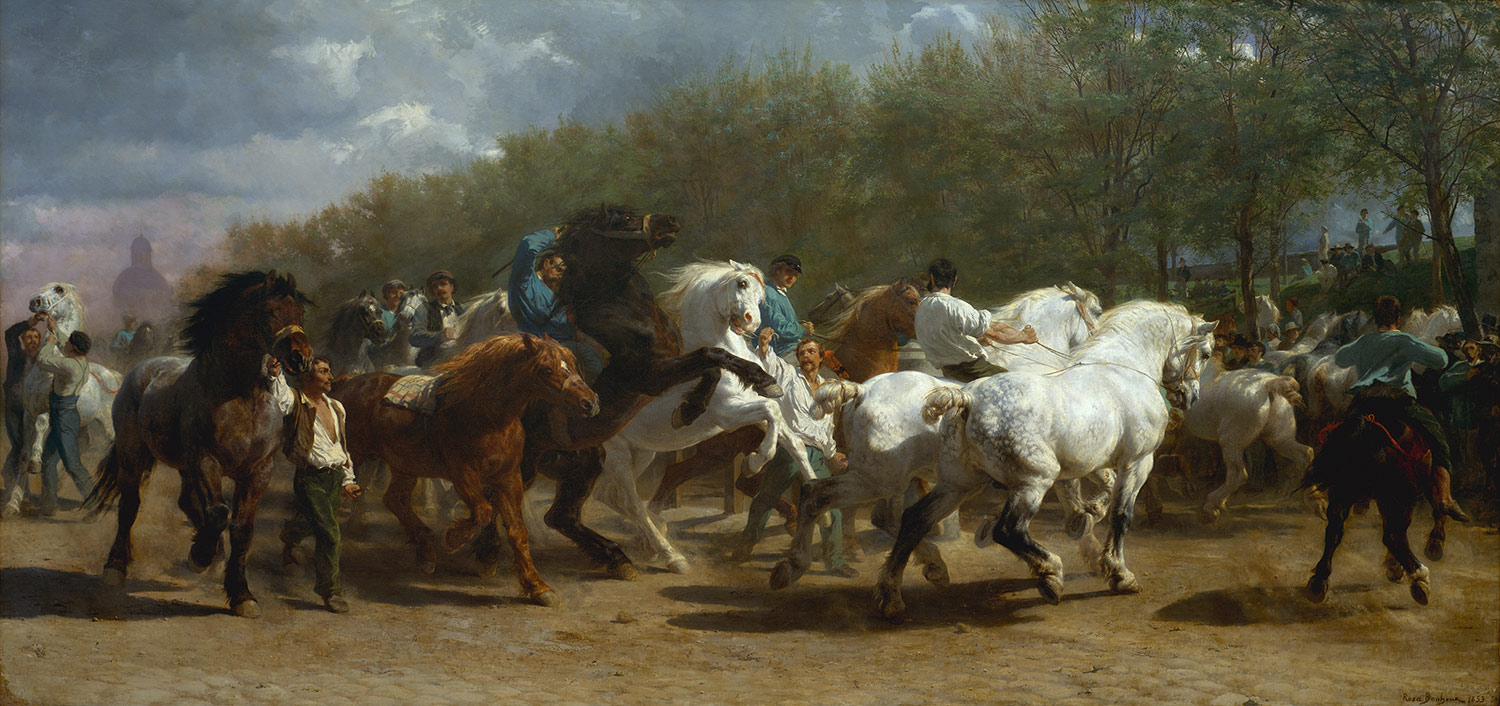
Rosa Bonheur. The Horse Fair. 1887. Oil on canvas. **
            In 19th century America, women’s legal status remained limited, despite their labor being essential to building colonial America and the new independent nation it became after the Revolution. The work of female American artists Harriet Powers focused on themes central to American life in the 19th century – labor, religion, substance, and family (Guerrilla 54-55). A former slave, Powers learned the art of quilting and depicted these themes on quilts by calling attention to issues of black and women rights and the importance of their roles in American life (Guerrilla Girls 54-55).
            As evident, it was largely economic and cultural conditions that dictate the role of women in Europe from the Middle Ages through the 19th century. Women artists were able to tailor both subject and meaning, usually in the European tradition of oil painting, to comment on women's role in society. Moving forward, as artistic abstraction and vast social and political change and upheaval took root in the 20th century, women would continue to make strides in both society and art. 

*Image descriptions link to image source. 
**The Horse Fair is currently on display at New York's Metropolitan Museum of Art. You can read about the work here.

Work Cited

Chadwick, Whitney. Women, Art, and Society. New York, NY: Thames and Hudson, 1990. Print. 


The Guerrilla Girls' Bedside Companion to the History of Western Art. New York: Penguin, 1998. Print.


(Illumination from the Liber Scivias)

Women "roles" throughout the history of Art


                          By: Jennifer Ezeuka


            During the middle age, there were many “expected” roles for women in Europe.  For the most part, women social roles “were circumscribed by a Christian ethic that stressed obedience and chastity” (Chadwick, 44).  The church controlled what women were allowed to learn as well as who could learn.  Despite the stress of obedience, women did participate in many activities such as building and even embroidery.  Women’s artistic and social life also depended on “noble birth.”  Being born into a family, which say was already into art gave many women an upper hand.  For example Hildegard of Bingen’s parents enrolled her in the convents for more artistic reasons, but her family was a little well off.
Elisabetta Siriani (self portrait)
            The Renaissance definitely was a better period for women, despite the little changes in things they were and were not allowed to do.  Like mentioned earlier, the more “successful” female careers as artist were made especially possible when being born into artistic families.  Examples include Sofonisba Anguisola, Artemisia Gentileschi, and Elisabetta Siriani.  During the Renaissance, womens role were still secondary to men and many weren’t educated.  Most women were the typical wife and bared children.  On the other hand, women were educated if their family allowed it or if they were part of the clergy.  “Bologna was unique among Italian cities for having both a University which had educated women since the Middle Ages”  (Chadwick, 87).  The school on Bologna was defiantly a big achievement for women.  In this school, they not only “learned art, but law, and philosophy” (Chadwick, 88).
            With time definitely comes progress and the 19th century was a good example.  In the 19th century women began careers instead the stereotypical motherhood role.  Women began things like quilt work, needle-work, and textile work.  A lot of the time, they were even paid to do these jobs.  During this time, female artist also greatly supported their peers.  “Friendships with other women provided some measure of freedom from the demands of marriage, family, and home” (Chadwick, 217).  Basically, the “sisterhood” that women created amongst themselves were as a result beneficial socially and a way to get them away from their stereotypical roles. 
(Mary Cassatt's The Child's Bath)
In the 19th century many women also took on the art of photography, this was good because photography was a new idea and women couldn’t be excluded.  The 19th century was also the beginning of women’s struggle for equality.  For example, women such as Edmonia Lewis paved the way for other African American artist.  Other prominent women during this period include, Rose Bonheur, Julia Margaret Cameron, Harriet Powers, Camille Claude, and Mary Cassatt.  All of these women stepped out of their comfort zones and for the most part became successful.
These “roles” influenced women in different ways.  Obviously during stricter times, (Middle Ages) most women obeyed and stood in their lanes.  They were wives, had children, and for the most part didn’t learn.  They couldn’t even do much in the church, but the highest thing they did do was become nuns.  Men and women did work together in guilds, but it was difficult to know the work of women because they barely put their name on pieces.  During the Renaissance, women received a little more rights, but were still secondary citizens.  Education depended on wealth and the class of families.  As for the work, there was an emergence of individual portraits and a decline in religious figures.  The 19th century was by far the most progressive era thus far in our studies of women in art.  Women had more freedom socially; they could go to school, travel, and experiment more with their art work.  (Sculptures, quilts...etc)  In the coming years, women continued to do more and more in the Art world and this is just the beginning. Below is a link on Youtube, basically it showcases many different ways women were portrayed in art, a lot of beautiful work, ENJOY!!  http://www.youtube.com/watch?v=9Zf3ET52BvA&feature=related


                                                 Work Cited
Women, Art, And Society. New York:Thames & Hudson Ltd, London, 2007. Print.

Gender roles, sex and power


The Middle Ages was a time where the church was considered a very important part among society and religion was the center point of everything. “By the end of the first millennium, Western Europe had evolved into a network of feudal Christian cities and kingdoms” (Guerrilla Girls 19). The class and status of a person mattered a lot because it dictated what one was and was not allowed to do. It ranged from the high upper class of the church (kings, Priests, noblemen, lords) and the lower class (serfs and slaves.) “Art in the middle ages became a didactic tool of the church” (Guerrilla Girls 19). As a result of this art such as illuminated manuscripts and tapestries along with religious objects and massive cathedrals became very popular during this time.

The roles of women in the middle ages were very strict and resulted in women having little to no power at all. As the Guerrilla Girls explain to us, women had two options during this time, either they would pursue a life as a nun or they would marry and begin their life dedicated entirely to their husbands, family, and household. For those who choose the path of the church, they were to enter into convents. Under the Benedict Rule “a woman must be a learner, listening quietly and with due submission. I do not permit a woman to be a teacher, nor must a woman domineer over a man; she should be quiet” (Chadwick 45). This rule formed the community of both men and women in the middle ages. Although women were equal with men when it came to religion, they were still not allowed to take on any major power roles such as preaching or becoming priests.  

Hildegard Von Bingen. Page of Scivias
“Despite the liabilities of the feudalism elsewhere, under it women did not lose all legal rights, status, and economic power. Often they managed large estates while men were at war or occupied elsewhere on business; by the thirteenth century the rapid growth of commence and city life has even produced a class of urban working women” (Chadwick 47). Looking back at art, women would create tapestries and illuminated manuscripts that revolved around the church and its messages. Hildegard Von Bingen was very well known for her pictures in the Scivias. She was believed to have the visions of God and with those visions she created stories that she displayed to the public. This was the type of work that many women during this time period created.    

As we move into the Renaissance the roles of women slowly start to change and this brings fourth new ideas in society and within art. “The development of capitalism and the emergence of the modern state transformed economic, social, and familial relationships in Renaissance Italy” (Chadwich 66). Much like before women were still inferior to men and much of what was given to men like the ability to enter and work in guilds/academies, learn in schools, earn commission on their work or become masters were closed off to women. However, “one of the few ways a woman could work as an artist was to be born into a family of artists that needed assistance in the family workshop” (Guerrilla Girls 29). This was the break through for many lucky women such as Sofonisba Anguissola, Lavinia Fontana, Elisabetta Sirani and others.

Artemisia Gentileschi. Judith Slaying Holofernes
The Renaissance allowed women exceptions to become independent artists and this was reflected in their work. Since some women artists were taught under their fathers, they had the privilege to be taught in workshops and learn with male painters. They learned styles that we referred to as Baroque (dark backgrounds, playing with light, rendering of the human form). In addition to learning advanced ways to paint women broke free from traditions and the male gaze. When women painted they no longer painted women as a sight like many male painters have done in the past, instead they gave women power and the ability to resist. Focus in paintings reflects the strengths that women had and were not able to display in real life. Women did not display a sense submission but of domineering control in paintings. A perfect example of this would be Artemisia Gentileschi’s Judith slaying holofernes. Because of her experiences and her talent she painted with a new found freedom.

The transition into the 19th century was a great leap into the future for women. In the previous century women were concentrating on still life paintings focusing mostly on nature. Some women even got great opportunities to paint for the royal family but in the century to come many women found better opportunities. "Modern feminist campaigns emerged out of a complex nineteenth century reform movements in Western Europe and America. Nineteenth century reforms movements were part of a growing middle-class response to widespread social and economic changes following the Industrial Revolution" (Chadwick 175). Women at this point in time had begun to enjoy more freedoms and privileges especially in the art community. There was a new rise in the demand for women to work outside of their homes. Many were trading in their marriage and home commitments to go out into the working world. Women were now getting jobs that were once only open to men. Then we also have the new found women artists who began painting great landscapes, making sculptures, and even moving out of their comfort zones to express themselves.

Harriet Powers Quilt
With the abolition of slavery, women rose to create quilting. These quilts became a very important part in history because they showed historical and biblical scenes. One of the most famous women to have her quilts in a museum was Harriet Powers. A freed slave, who was illiterate had created her quilts using the applique technique. Edmonia Lewis had become very famous for her marble sculptures. "In Rome she learned to work in the then-fashionable neoclassical style. She was taken under the wing of a group of well-to-do American women artists, writers, and intellectuals-many of them lesbians" (Guerrilla Girls 51). Even Photography rose to became an accepted form of art that women were able to take advantage of. People like Julia Margaret Cameron took pictures of old men and young women to as a way of expressing herself. As we can see there were many great advances for women to take part in and as the centuries continue we will continue to see even bigger steps for women.

The Guerrilla Girls' Bedside Companion to the History of Western Art. New York: Penguin, 1998. Print.

Women, Art, And Society. New York:Thames & Hudson Ltd, London, 2007. Print. 

Post 2 A long up hill battle for equality

During the Middle Ages the expected roles of women were to be care takers of the home. Women were only allowed to care for their husbands and raise their children always awaiting orders and never asking questions. Women were not allowed to read and write and were kept illiterate because their opinions about anything didn't matter much to men. If a man wanted to beat his wife for any reason he was allowed to and the woman could do nothing at all. Women had no rights at all and something very little as wearing underwear was prohibited unless a woman was "an Aristocrat, a Prostitute, an Actress, or a Window Washer." (GG 32) One of the only ways for a woman to have any kind of freedom from being a slave inside her home was to become a nun but that was not a privileged life either.
With the Renaissance came a lot of new opportunities for men and new ways of looking at the art world, but a mans views on women seemed to remain the same. Women were still looked at as care takers of the home and thought very less of when it didn't concern being a sexual object for a mans pleasure. As painters guilds and academies began to flood the art world attendance for male painters would almost certainly guarantee them success. Sure there were women painters but they were barred from becoming members of the painters guilds and joining the academies. Women would paint in secrecy and were only openly allowed to be a painter if she had grown up within a family of painters.
During the Middle Ages and into the 19th Century women Artist's were oppressed and completely overlooked until some courageous women began to make noise. Christine de Pizan was "the first woman known to have made her living as a writer in the Middle Ages." (GG 23)  Christine's writings told the stories of great and courageous women in history such as Joan of Arc and portrayed the female as a strong character capable of the same things that men were capable of. Christine was one of the first feminist to exist and used her intellectual talents to educate others about women and their benefits to society outside of the home. Another successful female artist by the name of Mary Cassatt during the 18th Century  became well known for her depictions of women " actively at work, at women's work, not as passive models or objects of the male gaze." (GG 56) Women had begun to take a stand through writing and their paintings displaying women in another light than in the shadows of men. Being as though women had no voice women artist made statements with their works of art painting the woman just as capable and intellectual as her counterpart.
All across the 19th Century rebel women have been fighting for equality through their writings and paintings; many of whom had garnered a level of success in the art world. Because of these rebel women who refused to submit and give in to the idea that a womans sole purpose was to be the voiceless, illiterate slave to her husband; women began to demand equality. the introduction of the Camera allowed women artist a new way to express themselves and be heard because the art of photography was fairly new and was something men did not have a firm grasp on. There were no classical photo's or canonical ways of being a photographer that women could be excluded from like painting. Along with the changes in technology came changes in the rights for women. Rosa Bonheur a very successful female Artist was allowed to dress like a man and mingle in society as a man would freely when women unaccompanied  by men could not. Rosa Bonheur  " encouraged women to be rebellious."  (GG 49)  Bonheur achieved a level of success which was not granted to women during the middle ages and had just as much or maybe more than her male counterparts in terms of wealth and success as a painter. As women were slowly beginning to be heard more and more female artist began to emerge like Edmonia Lewis and Harriet Powers who was a Slave not allowed to read or write but told stories of her life through her beautiful quilts.
From the Middle Ages throughout the Renaissance and until today, women have been fighting an uphill battle to be viewed as equal in all ways to men and be awarded the same rights and privilege's. If not for the brave women who chose to be heard and demand a place in a mans world instead of below his feet and cowering in his shadow women may have been still viewed by a majority of men as a caretaker of the home. The following link is to an overview of Women in England during the 19th Century and what is was like for them.
http://www.hastingspress.co.uk/history/19/overview.htm

Works Cited:
The Guerrilla Girls' Bedside Companion to the History of Western Art. New York: Penguin, 1998. Print.

Images used:

https://blogger.googleusercontent.com/img/b/R29vZ2xl/AVvXsEiZez3Rt9t7YubdaIo745nOYKtpX9-s2R85A6kJN_xF0J0-aBgRw0kcBzAGiz504yurmoIW9lPlbkhd7w1uP-I-INfnUF9Alta-43dRQE2qYUcgYSollYCw3JfHdNShAGe2Zi0KKv2attw/s1600/apronsfashio_G_20101027180622.jpg

 http://www.artcyclopedia.com/hot/images/women-artists-of-the-renaissance-sofonisba-anguissola-self-portrait-mid.jpg

 http://www.educationforum.co.uk/teachnet2006/suffragettes201.jpg

Friday, October 12, 2012

Group 6 Presentation Summary: Centennial Exhibition

Group 6 decided to do a skit for our presentation. The skit revolved around the Philadelphia Centennial Exhibition of 1876, the first big outlet for female artists to exhibit and represent their work. Because most of the female artists that decided to exhibit were amateurs, and the segregation that existed between male and female's works, the classroom (exhibition) was set up with many male painting printouts, with the female painting printouts in a corner outside of immediate view. Additionally, at the entrance of the the classroom as classmates would start filing in, one of us would hand out a "catalogue" that in fact contained a Guerrila Girls Document (linked) that detailed how female artists were treated during the Impressionism era.

The skit consisted of four characters: an unsympathetic conservative male that looks down upon female artists, a male sympathetic to the female artists' plight (although still having a bias towards women), Mary Cassatt, and Berthe Morisot. The skit consists of how these four characters interact with each other, and with the guests. The skit is linked below.

TL;DR
Who: Group 6 (Giselle Flores, Steve Simoes, Angela Tang, Vladimir Ventura)
What: A skit with Guerrila Girls' style document
Where: Philadelphia Centennial Exhibition
When: 1876
How: Conservative male, sympathetic male, Berthe Morisot, and Mary Cassat interactions


Here is the link for the public google doc of our finished work:

An alternative link to a pdf version:

Friday, October 5, 2012

     Group 5 Presentation Summary

     Women in the 19th century were finally enjoying rights and privileges which they did not receive.  The first change was that women were beginning to come together to create a "sisterhood".  They were exchanging marriage and domesticity for professional careers and supporting each other all the while.  The second change was with the introduction of the Industrialized society.  Women were getting paid to work in needlework and in textile manufacturing, where they were making cloth and other important needs.  The drastic changes can also be seen in quilting and sculpting as more women were hired to perform jobs usually given to males.
    
     Quilting was used to highlight many of the social issues that were going on during the 19th century such as the Women's Rights Movement and the Abolition of Slavery. Quilts were used to tell the story of the women that were making them. One important person that was creating quilts in the 19th century was Harriet Powers. Her quilts are the most documented early African quilts. She used the applique style in her quilting which had roots in the eastern/ middle eastern region to create three types of quilts, biblicale (right side), local legends and astronomical occurences. An important point to note about these quilts is that they were using them to focus on the important issues of slavery and womens rights in a way that was not used before. Their style of making a point correlates to the gorilla girls style with their posters.
  
     Harriet Hosmer was seen as a 19th century tomboy and one of the first of a group of women sculptors.  She created the Puck on a Toadstool (1956) which the replica was purchased by the Prince of Wales and insured her fame.  She also created Zenobia in Chains (which is on the left), where instead of depicting Zenobia as a defenseless woman, Hosmer showed her as a strong and independent woman that will not succumb to humiliation.  This sculptor is on display at the Huntington Library in Pasadena, California.

     As one can see, more women were moving away from their comfort zone of painting socially acceptable portraits and their unique work was also being accepted in society as well as being put on display for the world to see.  Many women sculptors created well-known works that can still be seen today on display.  Emma Stebbins created the Columbus statue that stands in Brooklyn, NY and Angel of the Waters Fountain (on the right) which is on display at Central Park, NY in Bethesda Terrace.  Next is Florence Freeman who created the Stonewall Jackson which was the first Confederate Civil War monument in America.  Vinnie Ream Hoxie created the Abraham Lincoln statue (bottom) which can be seen in Statuary Hall in the Capitol and Anne Whitney created a marble statue of Samuel Adams which is living in the Capitol in Washington.
 

Also, here is a funny youtube video we found called "Tabbos for Women in the 19th Century"
 

Tuesday, October 2, 2012

HELLO

Hello, My name is Collins Agyapong; a transfer student from Ghana in West Africa. Although Art and Women fit into my requirement, I chose it partly because of its impact on society so when I finally saw an opening in the class, I said yes, this is it. I believe that personnel growth is important in relations to both professional and academic goals. There is never a limit for the growth of an individual. The first decade of my professional working life has been in the media as a Broadcaster and in order to continue to contribute to society in this and other areas of interest, I am currently enrolling in the school of arts and sciences and my major is Bio. I would later enroll in medical school and the goal is to remain skillful as a health provider while I contribute my quota in both areas in the long run. Feminism is important in the lives of everyone in today’s world and it fits into my studies and areas of interest in different ways because it seeks to establish equal opportunities for women in education and employment and with my already established interest in Broadcasting and that of Medicine, feminism will further inform and enhance my decisions on issues such as the protection of women and girls from domestic violence, sexual harassment, and sexual assault as well as workplace rights, maternity leave, and against forms of discrimination against women which hitherto were not frown upon. In many parts of Africa from where I come, females were not allowed to take leadership roles until not very so long ago. However, one that I still remember and one that has over a century been an inspiration to many in Ghana, is a woman known as Yaa Asantewaa. Among other things, she showed that feminism could propel all of us to take on difficult moments and accomplish great things by defining, establishing, and defending equal political, economic, and social rights for not only women but society. Born in 1840, she led her compatriots to fight for the Ashanti Kingdom in the 19th century. She is noted to have addressed a council of men with these famous words: "Now I see that some of you fear to go forward to fight for our king. If it was in the brave days of Osei Tutu, Okomfo Anokye and Opoku Ware, Chiefs would not sit down to see their King to be taken away without firing a shot. No one could have dared to speak to chiefs of Asante in the way the governor spoke to you this morning. Is it true that the bravery of Asante is no more? I cannot believe it. It cannot be true! I must say this: If you, the men of Asante will not go forward, then we will. We, the women will. I shall call upon my fellow women. We will fight. We will fight till the last of us falls in the battlefield". With that, she took on leadership of the Asante Uprising of 1900, gaining the support of some of the other Asante nobility. Yaa Asantewaa remains a much-loved figure in the courage she showed in confronting injustice and highlighting the importance of encouraging more female leaders in society. Here, she is pictured in her war regalia.