Monday, October 15, 2012

Gender Roles.Sex.Power.


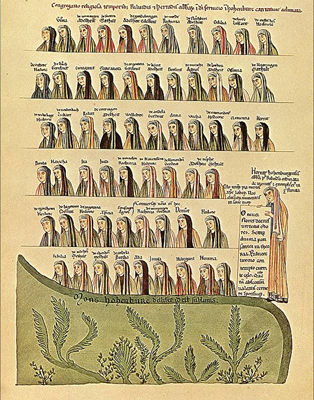
Hortus Deliciarum by Herrad of Landsberg
The roles of women were beginning to change in society after the Middle Ages. During the Middle Ages however, women did not play much of a role in society unless they were fortunate to be nuns. In the early Middle Ages, women were able to paint, copy write, and learn but, after the 10th or 11th century, they were deprived of the powers they had exercised earlier. (Chadwick 47). Keep in mind that during that period, there was feudal system and the Church was the central government controlling all aspect of people's lives. The people's purpose in life at that time was to work, pray, and go to church. Not many got an education unless they were wealthy. Women, if not from an elite family, did not get any education and their duties were limited to their homes. On the other hand, nuns did get an education while in monasteries yet they were not allowed to teach because that was thought of "domineering". St. Paul clarified what he believed women's role should be towards education, "A woman must be a learner, listening quietly and with due submission. I do not permit a woman to be a teacher, nor must a women domineer over a man; she should be quiet." (Chadwick 45) 

Nuns in the Middle Ages had an upper-hand at doing things that other women in their time were not able to do since nuns took up their time in the monasteries and the monasteries were the central power. Besides getting educated, some nuns such as Hildegard von Bingen, wrote illustrated manuscripts of divine messages and others made tapestries. Hortus Deliciarum (Gardens of Delight) was a medieval manuscript that was put together by Herrad of Landsberg to "praise the Christ and the Church," (Chadwick 56). In this manuscript, Herrad of Landsberg dedicated a page of all the sisters that were with her in the convent with their names written Latin or German. As the Enlightenment and the Renaissance started to come about, people began to think for themselves.
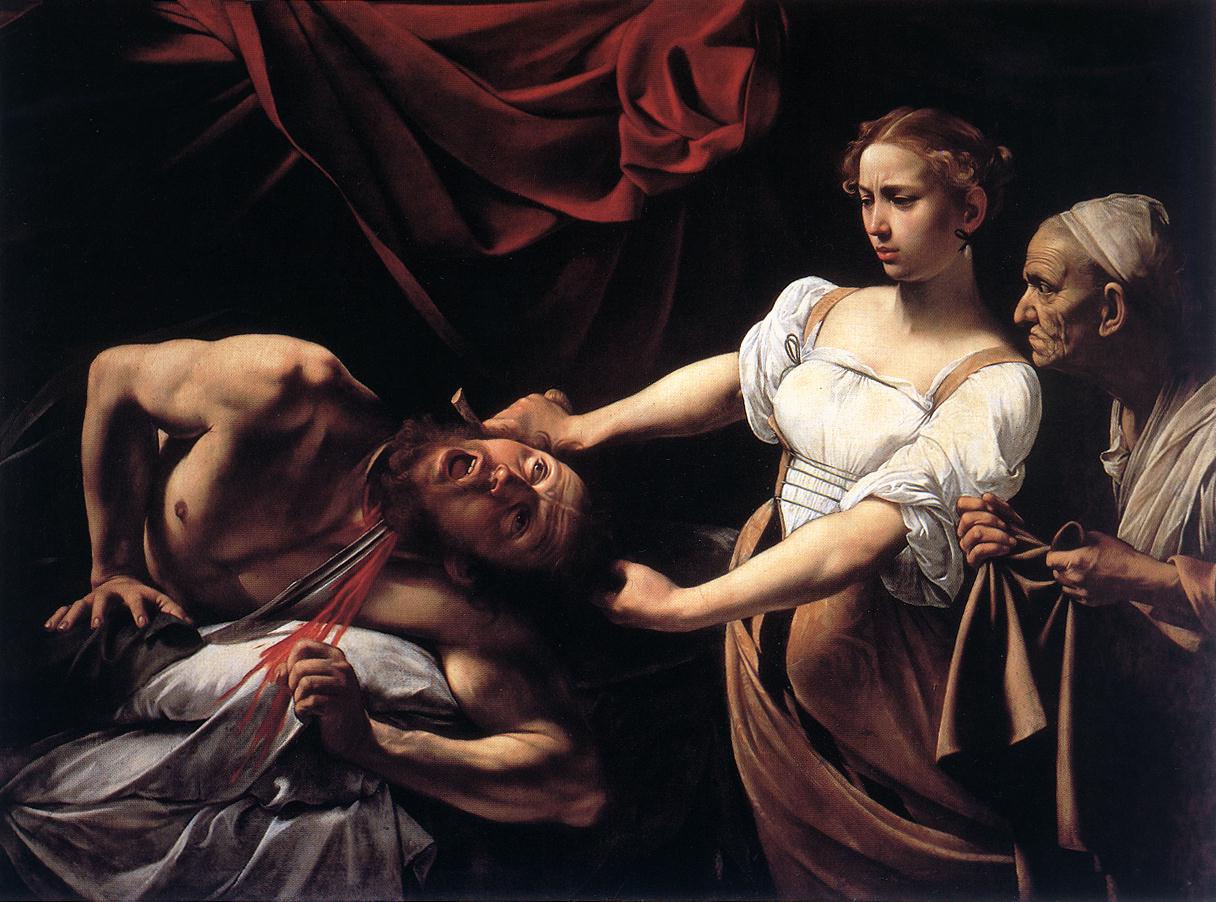


Original by Caravaggio
Remake by Artemisia 
During the Renaissance period, art and culture changed compared to the Middle Ages. It seemed as if the main focus of the Renaissance was revolved around the male artists on the rise to fame such as Michelangelo and Leonardo. However, there were female artists that were lucky enough to paint because they grew up in a family of artists that needed assistance in the workshop like Maria Robusti and Artemisia Gentileschi (Guerrilla Girls 31). Maria Robusti was a talented painter whose father invested in her by educating her in the arts and music. She helped out her father in the studio and was given many chances to paint elsewhere. Her father did not let her for he needed her to do the paintings for which he was taking all the credit. Another talented artist was Artemisia Gentileschi who worked in her father's atelier was raped by one of her father's assistants. She wanted to seek revenge from her rapist by exposing him but was not able to. The only way to channel her fury and humiliation was to remake the "Judith Slaying Holofernes" painting since it resembled Artmeisia's rape story. The original painting depicted Judith looking away from when she cuts off Holofernes' head but Artemisia's painting depicts Judith facing her act of beheading Holofernes.

During the 17th and 18th century, nude paintings came back into style but, men were only allowed to do learn nude paintings. The Netherlands were growing wealthy and people wanted to show off their materialistic possessions. As for the women painters in that period, they had started exploring other areas of painting such as still life, paintings of flowers and insects, and the growing popularity of portraiture. Judith Leyster was famous for her scenic paintings and some portrait paintings. She was apprenticed to Frans Hals who was a renown Dutch painter. She went on to have three male apprentices as she was a member of the Painters' Guild. As Leyster married and had children, she had less time to paint and eventually, she died unknown. Anna Maria Sybilla Merian took interest in a new area of art. She was interested in animal and plant life and most of her paintings were based on live specimens and botanical breeds. As Merian's interest of flowers and insects grew, she and her two daughters went to Surinam to document flowers and insects. She did Metamorphosis Insectorum Surinamensium where she painted numerous amounts of insects and flowers. She died in poverty however, her daughters kept on her work. 
In the 19th century, technology was advancing, women began to fight for their rights, the movement was called, Women Suffrage, and Impressionism was becoming the new art style in paintings. The camera was invented sometime during the 19th century and Julia Margaret Cameron at the age of 48, took interest in photography. She was a lonely woman after her children got married. Cameron ended up taking photography as a hobby after one her children gave her a camera as a gift. She took photos of beautiful women and intellectual old men. According to the Guerrilla Girls, the beautiful women personified characters from poetry or myths and the old men were simply themselves (p. 52). She excelled in her photography by producing books illustrating Tennyson's Idyll's of the King and other poems which she received great reviews. Although, she discontinued taking photos after her husband and her move to Ceylon, she was part of  something innovative, "a new kind of art" (Guerrilla Girls 53). From the Middle Ages throughout the 19th century, some women were lucky to enough to get educated and show their expertise in art for the fact they were either from noble families or were born into artistic family or simply because they were lucky. Others did make an impression in their artwork such as Judith Leyster and Maria Robusti but then, their work did not prosper after getting married and having kids or after their death. Then, there were even other artists who regardless of whether they got married and have kids continued to make their artwork prosper such as Artemisia Gentileschi. 

Work Cited

Chadwick, Whitney. Women, Art, and Society. 3rd Edition. United Kingdom: Thames and Hudson Ltd., 1990.

Girls, Guerilla. The Guerilla Girls' Bedside Companion To The History of Western Art. England: Penguin Books., 1998 


Womens Roles in the 19th Century


     Women in the Middle Ages in Europe did very menial and simple tasks.  Womens' roles in those times were the housewife, a mother or possibly becoming a nun.  A women's place in society was determined by where her husband or father stood.  They were not allowed to do things that the men did.  For example, ``He was also the director of an art school for girls, where Rosa helped out and learned to paint.''( Guerilla 47)  Rosa Bonheur, got the opportunity to attend art school because her father was involved there.  If it was any other girl, she would not have had such a chance.   The way of life for them was very strict.

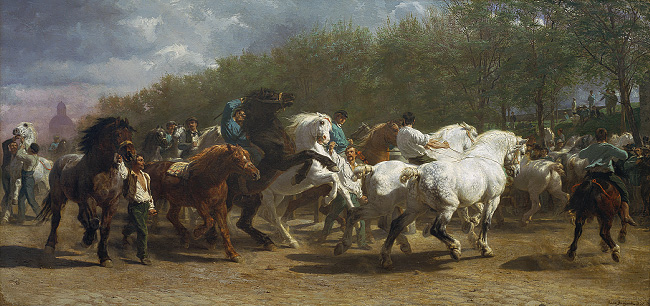
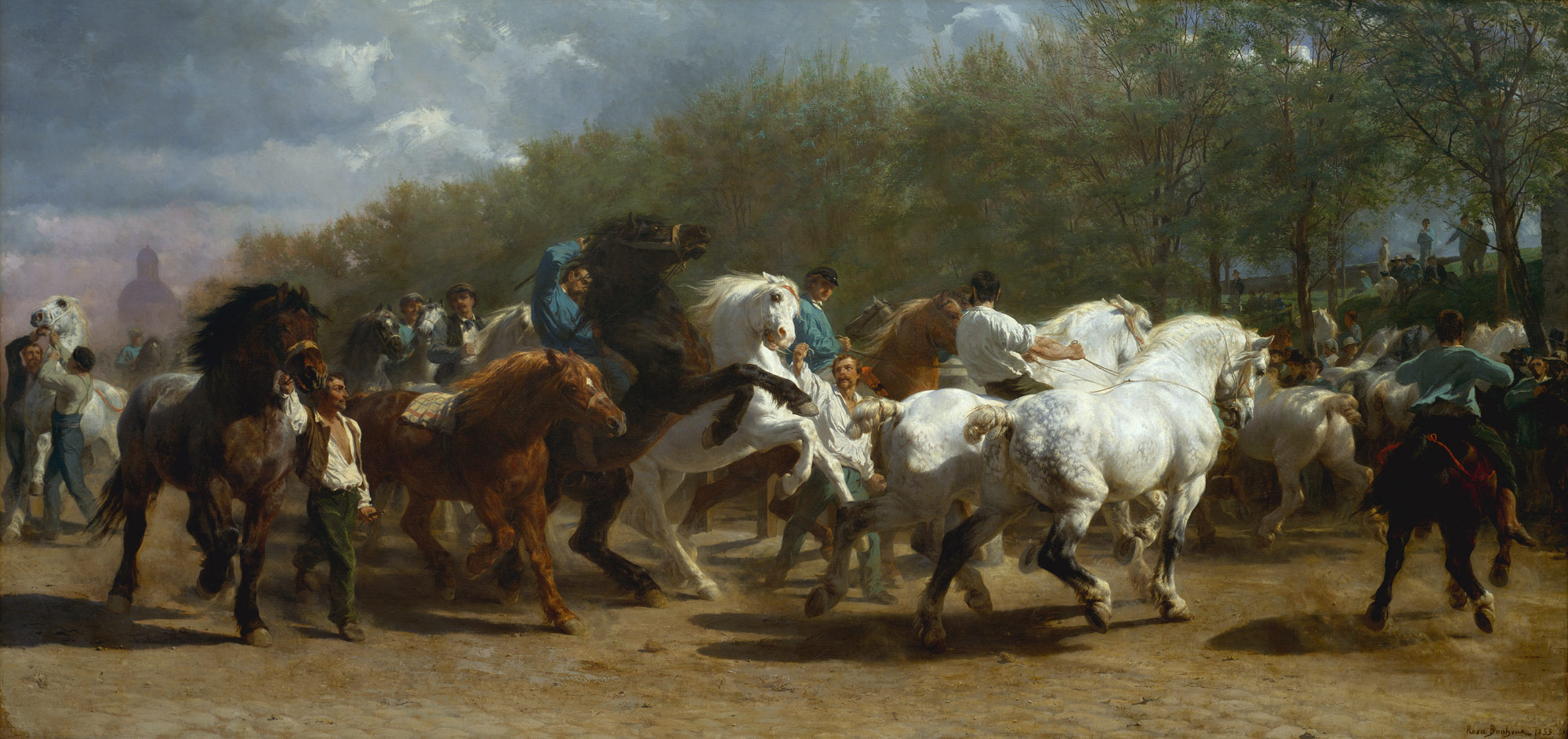
The roles of women changed throughout the nineteenth century very drastically.  Women were beginning to get a name for themselves.  Women were beginning to become known for their art.  As a successful artist, Rosa made lots of money selling her paintings.  Her painting, The Horse Fair, made her one of the best- loved artists in Europe.  In that painting, it depicts the women trying to break free from the controlling mens' grasp.    Rosa was not afraid to stand up for what she believes is right, which is women in the art world.  Rosa, as well as other women artists were being acknowledged for their works.  Sometimes they were even treated equal to men.  

The Horse Fair, 1853–55
Rosa Bonheur (French, 1822–1899)
Oil on canvas
Another interesting women in the nineteenth century was Harriet Powers.  She was a freed slave, and was married with children. She was illiterate, but she knew the bible very well.  She stitched stories into her quilt, basically recording her life. ``Eventually the first quilt made its way to the Smithsonian; the second was given to Boston's Museum of Fine Arts.''( Guerilla54)  Even though her life was a struggle, she still found a way to come out on top.     It is great to see women being able to express their feelings with art, and not be reprimanded for it. Another exception of the nineteenth century women artists is Lilly Spencer.  She was a married woman, whose job was to use her art to support her thirteen children and her husband, who stayed at home.  

Even though women were moving along and making themselves noticed, they still had that stigma of being a women artist.  Art by a woman will always just be '' good for a girl'', not good in general.   Women were only allowed to paint pictures of other women, or simple things.  Women could not paint men or nude pictures of men.  It was a double standard and it was not fair.  `` Although women's role as spectacle continues to dominate much of the periods visual culture, female spectatorship begins to emerge as a social reality within spaces like those of crowds, stores, and mass-market advertising.''(Chadwick 242)  
Lilly Martin Spencer
         Women have made positive effects throughout the nineteenth century with their artwork.  They have come a long way to make their art be seen.  They were finally viewed as individuals, and not just women artists.    They took a stand in what they believed was right, and because of them, I am proud to be a women .  Today, women are equal to men, and some women even make more money than men do.  It is very nice to see how far we have come.   Below is a link to some of Harriet Powers quilts and information on her work .www.earlywomenmasters.net/powers


Work Cited

Chadwick, Whitney. Women, Art, and Society. New York, NY: Thames and Hudson, 2002.

Gender roles, sex, power

        Women in the middle ages were seen as inferior to men in the most extreme ways.  The people looked to the church in order to know how to behave, and "the church's hierarchical organization reinforced the class distinctions in society; its patriarchal dogma included a full set of theories on the natural inferiority of women which can be traced back to ancient Greece and the Old Testament (Chadwick 44)."  "Women's social roles...stressed obedience and chastity (Chadwick 44)."  Women were told by men that they were to behave in a certain way; those same men were able to enforce their rules and regulations because they were backed by the Church and law.  Men created the laws, they were able to work and own land while women were left to depend upon men for survival.  There was only one place were women could be educated, the convent, but even there it "it was often determined by noble birth," whether or not you were allowed to go.  The art made during this time focused mainly on religious aspects because of how powerful the church was at the time.  But as with every time period rebels rise.  Christine De Pizan was the "first woman to have made her living as a writer in the Middle Ages (Guerilla Girls 22)."  Christine was a mother who needed to support her children.  She started as a simple copyist and worked her way up.  She eventually became " famous and influential during her lifetime and for centuries after (Guerilla Girls 22)."
The Renaissance continued to close women out of guilds, ateliers or workshops.  They were considered inferior.  Women were only allowed to work or learn in these places if she were born/married into a family of artists.  They could then assist their fathers/husbands/brothers in their work.  Any work that was considered exceptional was either criticized for being another man's work or a rare exception.  Women like Properzia de Rossi was a very well known sculptor who was "commissioned to produce marble sculptures for the Church of San Petronio in Bologna (Guerilla Girls 31),"until society began to accuse her of prostitution.  Lavinia Fontana was known as a talented painter.  She was asked by the Pope to come to Rome but she refused in order to remain at her father's side.  She was given the credit due to her but only because she was controlled by men her entire life.
         Art work in the 17th and 18th centuries was very diverse.  Those living in England, France, and Italy focused mainly on heroics and very grand themes that included nudes.  Women were excluded from learning how to draw men in the nude because of their sensitive dispositions and the fact that if they were to "know" a man's body then her purity and innocence would be lost.  Angelia Kauffmann defied conventions and drew heroic scenes that drew much attention, both positive and negative.  She had many "close relationships with other male colleagues (Guerilla Girls 44)," and was accepted into the Accademia di San Luca.  "She belonged to the English Royal Academy, and was accepted in a man's world (Guerrilla Girls 44)."
           In the meantime, in the Netherlands women were able to paint and excel at what they painted.  They were able to paint domestic scenes as well as floral arrangements.  Women were allowed to paint these subjects and were able to perfect their techniques.  The middle class was becoming the new clients and wanted paintings that would show their new prosperity, this is where women were able to begin to carve a path into the art world, however slight. Tulips "symbolize the wealth of the country (Guerrilla Girls 43)," Rachel Ruysch painted tulips and sold them in order to make a living, along side her husband.  She earned more for her work than Rembrandt did for his.  Men later on criticized women for their work in this time period, they were considered hobbies and barely worth looking at, if not flat out imitations of better artists.
           In the 19th century Rosa Bonheur addressed the problems facing women artists.  She was a famous painter who loved to focus on domestic cattle.  Horses and cows were her passion, she painted them with success and "won a gold medal at the Salon of 1848 (Guerrilla Girls 47)."  She barely fully recognized the men in her paintings.  the Horse Fair showed men in the painting but left their faces in shadows or they did not leave much of an impression on the viewer.  The main focus of the paintings were the animals in the scene.  Women through out this time period became bolder and more self confident.  They were willing to go far and wide in order to fulfill their dreams.  They had more freedom and used it to the best of their abilities.

Works Cited

Chadwick, Whitney. Women, Art, and Society. New York, NY: Thames and Hudson, 2002.

The Guerrilla Girls' Bedside Companion to the History of Western Art. New York: Penguin, 1998. Print.


Gender Roles, Sex, Power (Post 2)

Gender Roles, Sex, Power (Post 2)

     In the past, women were seen as an inferior race placed on the earth solely to fulfill men's pleasures.  One can see the expected roles of women especially in the Middle Ages.  Chadwick explains that "women's social roles remained circumscribed by a Christian ethic that stressed obedience and chastity...maternal and domestic responsibility... feudal legal system...[and] control of property" (Chadwick 44).  Back in the day, women's main role was to follow in their husbands shadows, rear children, take care of the home and cook and clean.  The biggest change that occurred was that women were encouraged to take part in the management of family property and in general economic life, such as masonry and embroidery.  During the war, most men were drafted as soldiers so women were given the right to take on jobs at home that men were responsible for, such as managing property.  As for royalty, women were allowed to become rulers of small principalities and Chadwick points out that "the eleventh and twelfth centuries encouraged large numbers of women to take up religious lives" (Chadwick 53).  Women were seeking to escape harsh treatment of their kind and their only solution was to become nuns.


     Roles for women changed drastically throughout the Renaissance and into the 19th century.  As more women became nuns, they soon began to sell their art for their foundations.  Women were still kept away from public activities relating to the government, but Chadwick states that "a literate wife was becoming essential to the mercantile families" (Chadwick 68).  As the silk, wool and banking industries grew, more commercial families benefited from having their wives active in the business.  One can see that women were being granted more freedom with being able to work, but they were given work that would be useful in household duties.  Chadwick goes into further detail by repeating that "Women's virtues are chastity and motherhood: her domain is the private world of the family" (Chadwick 71).  One can see that even though women were given some freedom, they were still seen as inferior to men. 
     
Sofonisba Anguissola Self-Portrait (1561)
     But, as time went on, more women went into painting, which was an acceptable pass-time as long as they did it in private and the only time that they would get a little recognition would be if they were born into artist families or married into a family that supported them.  One artist that opened the possibility of painting as a socially acceptable profession was Sofonisba Anguissola.  Chadwick explains that "she paints herself as if she were being painted...its positioning within patriarchal structures of knowledge, and the role of woman as an object of representation" (Chadwick 78).  Anguissola opened the idea to self-portraiture, where the woman was no longer seen as an object of the male gaze.  She was also the first woman to get recognition and respect for her work.

                                                                                         
Artemisia Gentileschi Judith Decapitating Holofernes (1618)
     During the seventeenth century, paintings began to change completely as more women began to create art.  Instead of painting self-portraits or other religious themes, they began to create works of art that touched upon images of women retaliating against the male gaze.  Chadwick states that "the growth of naturalism in the seventeenth century led to a new emphasis on the depiction of courage and physical prowess in representation" (Chadwick 106).  A prime example of retaliation was Artemisia Gentileschis' Judith Decapitating Holofernes.  She uses a very dark background to emphasize the two women beheading the men.  In that time, women were viewed as sensitive creatures, which was odd because     in the painting, the women were angrily staring at Holofernes with evil gleaming in their eyes as they perform a "manly" deed. 

     As painting became extremely common, women began to branch off completely by painting flowers and botanical illustrations.  "Women were...critical to the development of the floral still-life, a genre highly esteemed in the seventeenth century but, by the nineteenth, dismissed as an inferior one ideally suited to the limited talents of women amateurs" (Chadwick 129).  Chadwick goes into detail about how this particular type of painting required patience and a steady hand which women had due to housework, so society accepted it solely because it was an inferior art technique compared to what the men were painting.  By the eighteenth century, there was a large influx in women artists painting publicly.  But, Chadwick explains the real reason why it was becoming more socially acceptable was because as long as the women were "emphasizing beauty, gracefulness, and modesty" (Chadwick 139), they were allowed to paint.

     Throughout their growth as artists, women came across many obstacles.  One main problem was being born into a poor or conservative family.  Most of the women artists that were receiving recognition was mainly because their family was full of artists, so in turn they became well-known artists due to their support from home and/or they married into rich families where their husbands supported them.  Another issue they came across was that the conservative society did not accept their work.  Lastly, society believed that women's artwork was actually created by their male teachers or they copied works created by men and signed their name on it.


Rosa Bonheur The Horse Fair (1855)
     Finally, in the nineteenth century, women overcame these challenges by fighting the battle of prejudice together.  Chadwick explains that "women artists risked "unsexing" themselves" (Chadwick 117).  Women were slowly realizing that the only way to stand up and fight was if they created sisterhoods to break away from the social norm.  The first woman photographer came from the nineteenth century, Julia Margaret Cameron, who saw photography as an art.  Edmonia Lewis became the first African American woman sculptor and Rosa Bonheur introduced animal paintings as she used her art to express the realities between male and female.  Chadwick explains that "images of animals frequently symbolized the vices and virtues of women" (Chadwick 192).  This can be seen in The Horse Fair, where the horses symbolize women who are finally breaking free from the male grasp even though the men are trying to hold on.


Works Cited

Chadwick, Whitney. Women, Art, and Society. New York, NY: Thames and Hudson, 2002.

Gender Roles , Sex Power


During the time period of the Middle Ages, the expected roles for women in Europe were to provide for their homes. Women were, “ the virtual prisoners of the men in their lives” (GG 19). Women were not able to read or write, their opinions or anything did not mean anything during this time. Not only could they not speak their minds but also they could not inherit land and hold fiefs. They were entrusted with the charge of castle when their lord went away.  Women were set to be housewives and were, “ required to be faithful to her husband, and adultery could be punished by flogging or being buried alive” (GG 22). Being that said women couldn’t defend themselves, a man was allowed to her. The only women a women could get a sense of freedom was by becoming a nun, although it was not a privileged life either. Women, “ social roles remained circumscribed by a Christian ethic that stressed obedience and chasity” (Chadwick, 44). Women were also controlled by the church, meaning that the church told them what they were allowed what to learn. “Nuns wrote book on medicine, science, and sacred music” (GG 22). Nuns were given important voice in the church. This gave women some privilege being a nun.
            As for the Renaissance, this was a period were it was much better for women compared to the Middle Ages. During this period woman were beginning to develop more sense of freedom doesn’t wasn’t easily accomplished. This was also when men, “began to obsess over and objectify the naked female body as never before” (GG 47). Being that said women were still known  for being the stay home and take care of the house but women did start to intake photography. Photography was something new to women and they couldn’t be excluded from this, it allowed them to express themselves and be heard because the art of photography. A famous woman painter, Rosa Bonheur, she became successful from most of her paintings. She loved women and animals. One of her famous paintings, The Horse Fair, made her be recognized as the best artist in Europe. “ [Her] animals, although full of life and breed, have no pretensions to culture,” this was quoted among the Daily News (GG 48). Aside from her painting making her famous and being recoginzed she also started the change of women. Rosa reached out to women by telling them, “ Let women establish their claims by great and good works and not by conventions”(GG 48). Women started to make a change and started doing work, similar to men work.
            During the 19th century and the Middle Ages the roles of women that had been developed had changed their perspective in how they saw things, especially what they painted. Referring back to Rosa Bonheur, she was an example of how rebellious women became to be. Rosa didn’t care of how people looked at her she would smoke and wear what she wanted without thinking twice about what people thought. She even painted her work as if she was a man. The textures of how she painted her work defined her work as a men’s painting. She was brave enough to paint her work while observing men. She showed women how the roles were no longer based on how woman were the ones in portraits but how men were as well.
Women were trying to make their names known and fight for their rights through painting and writing. The use of technology helped women change their rights for themselves. As women slowly got to get changes done, more artists and slaves such as Harriet Powers were known. Harriet Powers was not able to read or write but she managed to memorize stories from the bible and create the stories in quilts. Women had the power to progress while fighting their way up to where they were equal. Paintings made by women was just considered a painting that was ‘great for a woman.’ They had to illustrate the word women after it just to say that it was a woman that made it. They were denied to pain any nude painting of men as well.
            Although women had their sense of freedom, they still had rules to follow along. Being a women men that if you ever wanted to be educated it was just as impossible. Education was easier for men to achieve than women. Women had to show their strength and power in their work of art. By showing their struggles and achievement it help others see what women went through. Till this day we continue to see women making more changes compared to the adventures they have done during the 19th century. This link below helps to illustrate more of what women had to go through during the 19th century.

Work Citied

Chadwick, Whitney. Women, Art, and Society. New York, NY: Thames and Hudson, 1990. Print. 

Chadwick, Whitney. Women, Art, and Society. New York, NY: Thames and Hudson, 1990. Print. 

Group 4 Presentation Summary


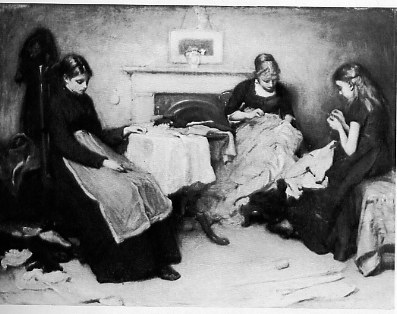
      “Women were presented as morally and spiritually superior to men, and given primary responsibility for managing the home, but their lives were tightly restricted in other ways.”  (Chadwick 176) During the 19th Century upon Queen Victoria’s reign the status of women changed.  New laws were put into place; The Divorce Act of 1857, Married Women’s Property Act of 1870, etc.  Following the Industrial Revolution and the result of the war many men could not support their female counterparts, which forced women to work and explore other options of income. The women/wives of middle and upper class Victorian homes couldn't juggle the managerial and cleaning duties that presented them so the jobs of servant and governess came into play. This then freed up time for bored middle and upper class wives and made servants and governess the subject of art. Some artists such as Lady Hawarden who was an amateur photographer, Anna Blunden who painted The Seamstress (1854), Rebecca Solomon who painted The Governess, and Emily Mary Osborn who painted Nameless and Friendless. 


      But that wasn't the only interest of female artists; Harriet Powers, a freed slave made quilts that represented biblical stories, current events and astronomical phenomena. Mary Cassatt, an American Impressionist painter, involved in the Suffrage Movement focused on the lives of women partaking in work or active at work. Camille Claudel, a sculptor of the anatomy of the human body worked alongside a Master sculptor by the name of Augusta Rodin. She was unpaid, his lover, a model, collaborator and unappreciated which all ended up making her crazy. Edmonia Lewis, another sculptor who was part African American part Chippewa faced many difficulties not only with the art world but with the world in general. She focused on making sculptures of Abolitionist heroes, learned the Neoclassical Style and was considered exotic oddity because she was a black woman.  Julia Margaret Cameron, a British photographer was given a camera as a present and began to take pictures at the age of 48 of famous people of the time; her career only lasted 11 years. 

     An artist by the name of Rosa Bonheur made the paintings of animals her life. As a female cross dresser she challenged the norms of society’s perception of women.  Although she separated herself from the female artist stereotypes a debate in Britain stated “the lives of women as well as animals and it is important for what it reveals about the way that control over the bodies of women and animals was articulated around identification with nature and culture, sexuality and dominance. The same images which expose the helplessness of animals were used to reinforce the subordinate of male power and privilege.” (Chadwick 195)Women have challenged and explored to make great strides of success in history but the Male Gaze always continues to interfere. 

In 1877 a novel named Black Beauty written by Anna Sewell was thought to be a book about an “autobiography of a horse but instead it was about the cruel oppression of all creatures, especially women and the working class.”  (Chadwick 196) 


The Roles of Women Changing Over Time

             Women in history were always suppressed and thought of as inferior to men. But then women in the middle ages in Europe started to have several different roles than they ever did in society. Common expected roles in society at first were things such as being a housewife, mother or becoming a nun. But then women started to branch out and start to do more intellectual activities. They began to draw, paint, read and other things beside housework. Female activities such as paintings grew stronger, from beginnings of painters such as Hildegard who created her representation of the divine in her works "Scivias" (Guerrilla Girls 26).  
             Going into the 19th century, women were beginning to get a name for themselves, but it wasn't as easily done. Many painters such as Gentileschi wanted to be known separately from their fathers from whom they had learned from and worked under their entire lives. In the 19th century, women also began to partake in photography since it was a new concept  and "there was no canon for them to be excluded from" (Guerrilla Girls 47). A woman painter, Rosa Bonheur gained much success from her painting, Ploughing in the Nivernais, as shown below. This started to be a change for the regular roles of women that were expected in that century. With women being recognized as being just as able as men, they started to do more jobs that men did such as  labor work. 
           The new roles of women in the 19th century and Renaissance changed what they wanted to paint and show to the world. Their everyday lives were affected as well since they were no longer just the housewives anymore. Bonheur for example, was bold enough to wear trousers, smoke in public  and keep her hair short like a man which was all considered too inappropriate for women long ago. Her artwork even shows it, in the same painting I mentioned earlier, she shows her boldness as well. It shows she is bold enough to paint animals such as oxen and just sit and observe at the man doing his job rather than being observed herself. For once, it was a different subject being painted rather than a woman being shown or just a portrait of any person. 
  
Ploughing in the Nivernais, Rosa Bonheur
           
       Women still had to face many challenges even though they were beginning to be more free than ever before. Paintings by women artists were considered "good for a woman", never just a good painting. In the 19th century woman could not even be the legal guardian of their own children or have a job without the permission of your husband. Although women could now become doctors and lawyers, being able for a woman to survive medical or law school was pretty much impossible. So even though women had new roles, it was hard to strive in these roles. Often academic offerings to men were still not free to women. Women were denied to the right to paint nudes of men but they could still be painted nude. 
         To show women were just as strong as men, in their artwork they showed how the struggles they faced would not stop them from doing anything.  The famous women artist, Elizabeth Thompson in the 19th century show how she remained strong. By choosing such bold topics to paint such as war and fighting, it showed not a thing could bring her down. In the painting, "Return from the Inkerman", she shows men as weak when returning from a battle. Depicting men as beaten down was a risky move, a woman showing men as lost and not superior for once when women are deemed to be the inferior ones. With women like Elizabeth and in the late 19th century is how the older society eventually started to progress, without bold move there would  be no change. 

Return from the Inkerman


The Guerrilla Girls' Bedside Companion to the History of Western Art. New York: Penguin, 1998. Print.