Monday, November 19, 2012

Ana Mendieta

Portrait of Ana Mendieta

Ana Mendieta a famous artist of the twentieth century had accomplished so much in such a little amount of time. Her story begins in Havana, Cuba in 1948, the origin of her birthplace. She was always interested in art and eventually decided to pursue it. “She studied art at the University of Iowa, met many avant-garde New York artists, and eventually moved to New York after graduation” (Guerilla Girls 89). Her work was considered very conceptual and performance based. She was interested in ritual and so her work was made using her body and the objects she used became her art (Guerilla Girls 89). Displaced from her homeland as a result of the conditions going on in Cuba at the time with Fidel Castro and exiled to the United States, she had a very different cultural perspective when it came to making art.

Ana Mendieta, along with other female artist of the time created performance art that was meant to challenge the spectator and think about important issues that were going on at the time. “Mendieta’s artistic roots lay in feminism and in the anti-commodification tendencies of earth, performance, and process work in the 1970s (Chadwick 372). One of her first perfomances was in 1973, where she used blood to protest against rape. People who saw her work were shocked at the statements she was making. She was facinated by violence and definitely projected it in her blood series. These are said to be the most intense and powerful works done by her. "Untitled (Rape Scene)" (1973) is the record of a performance/ installation Mendieta created in her apartment in Iowa to recreate the scene of a real violent rape-murder of a young woman that March that had been reported in detail in the press. Although the image immediately suggests a feminist politics, a statement against violence against women, when coupled with the series of slides shown in a vitrine nearby of Untitled (People Looking at Blood, Moffit) (1973), rows of mundane street shots of ordinary passersby in front of a doorway where Mendieta spread animal blood, the effect is not a condemnation of violence, but a sense of detachment and displacement (Brookylnrail).

Untitled (Facial
Hair Transplants)
"In the series of headshots dubbed Untitled (Facial Cosmetic Variations) (1972), Mendieta grotesquely transforms her visage with stockings pulled over her head, torn in different places, caked on makeup, wigs, and distorted expressions; while the related series Untitled (Facial Hair Transplants) (1972) documents the transfer of fellow student Morty Sklar’s beard to Mendieta’s face. Although Mendieta appears in both projects, two of very few works in which her face is visible, she is not revealed in any traditional sense of a self-portrait" (Brooklynrail).

Silueta Series 
Her most famous well known work was when “she began imposing the traces of her five-foot body on the earth in the environs of Iowa City, Iowa, Oaxaca, Mexico and other sites, outlining it with ignited gunpowder, stones, flowers, and fireworks or having herself bound in strips of cloth and buried in mud and rocks” (Chadwick 372). All her materials that she works with are natural and can be found in nature. The cool clear water running over her body, face down, head turned to the sky away from the camera in "Untitled (Creek)" (1974) captures a silueta of water, possible only by the body’s interruption of the natural flow of the creek. In The Tree of Life series that marks the beginning of the Siluetas, Mendieta incorporated her body into the landscape by covering herself with mud or flowers and grass, making a raised impression against a tree or in a field. The scale of the works never exceeds the scale of the body, and the effect is an overwhelming sense of intimacy: with the land, with the viewer, with her own body" (Brooklynrail).

Tragically, Ana Mendieta died at age thirty-six, the result of a fall from an apartment window in New York in 1985. She left over 200 photographs documenting her body works, and a generation indebted to her innovation and ideals. Her husband Carl Andre was with her during the time of death and he was believed to have murdered her after they got into an arguement. "In the wee hours of the morning of Sept. 8, 1985, Carl Andre, a successful avant-garde sculptor, argued with his artist wife, Ana Mendieta, who then somehow ''went out of the window'' (Mr. Andre's phrase during his emergency call to 911) of their 34th-floor Greenwich Village apartment. She may have committed suicide, as Mr. Andre claimed, or he may very well have thrown her, since she weighed only 93 pounds compared to his 175. There were no eyewitnesses. A doorman in the street below had heard a woman screaming ''No, no, no, no,'' then the explosive thud of Ana Mendieta's body landing on the roof of an all-night delicatessen. The bedroom from which she plunged was in disarray, Mr. Andre had what appeared to be fresh scratches on his nose and forearm, and his story to the police differed from his recorded statements to the 911 operator an hour or so earlier. The police arrested him" (New York Times). Her death was mourned by millions because the world had suffered the loss of one of their most successful, creative and inspirational artists.  


                                                                 Bibliography


Chadwick, Whitney. Women, Art, and Society. New York, NY: Thames and Hudson, 2002.

Business.'', Vincent Patrick; Vincent Patrick Is The Author Of The Novels ''the Pope Of Greenwich Village'' And ''family. "A DEATH IN THE ART WORLD." The New York Times. The New York Times, 10 June 1990. Web. 17 Nov. 2012. <http://www.nytimes.com/1990/06/10/books/a-death-in-the-art-world.html>.

Heuer, Megan. "The Brooklyn Rail." Ana Mendieta: Earth Body, Sculpture and Performance. Brooklyn Rail, 2005. Web. 17 Nov. 2012. <http://www.brooklynrail.org/2004/09/art/ana-mendieta-earth-body-sculpture-and-pe>.

The Guerrilla Girls' Bedside Companion to the History of Western Art. New York: Penguin, 1998. Print.
Post 3: 20th Century Artist


Self-Portrait 1945
     Born in 1899, Pan Yuliang became an award-winning Chinese painter and well-known for being the first woman in China to paint in the Western style as well as her extraordinary life.  Her story was very unique, which helped her in her artwork.  Yuliang became an orphan when she was a child and was sold to a brothel.  She later met Pan Zhanhua, who made her his legal concubine and encouraged her to take up oil painting.  The article in Chinadaily.com explains that Zhanhua took her to Shanghai where she "entered Shanghai Art School to learn western painting from Wang Jiyuan [and] after graduating...she went to France to study in Lyons and Paris" with the help of Zhanhua (Xinhua).  "In 1929, Liu Haisu invited her to teach at Shanghai Art School while she was in Rome" (Xinhua).

     Even though Yuliang had support from Zhanhua, he was not able to help her through the societal conditions that she had to battle.  During the 20th century, she was creating Western-style oil paitings when the norm in China was "traditional styles, using ink.  Yuliang emphasized on individual expression, including the eroticism contained in the naked female figure" (The Guerrilla Girls 72).  She was painting many nude paintings of herself along with other women, which was seen as pornography and was forbidden in a very conservative China, which was run by communism, where women were not supposed to paint and if they did they were supposed to be painting traditional Chinese art, not Western art, which was despised.

     Also, many people harassed Yuliang because of her past as a prostitute.  In the article, A Lonely Legacy of Pan Yuliang, the author states that "[Yuliang] was forced to leave China [because]...someone tore up a piece depicting a strong man moving a stone to let a small flower under it grow up, and wrote: 'This is a prostitute's carol to a whoremonger'" (A Lonely Legacy of Pan Yuliang).  When she taught at the Shanghai Art School, she was faced with harsh comments and criticism from people all around her, where they brought up her past in the brothel and they denied her paintings, calling her a prostitute along with other viscous names.  

Fan Dancing 1955
     Even though Yuliang was faced with many harsh criticism, it did not stop her from creating art.  "Her works combine both oriental and Western painting styles, and are full of her own spirit.  She has contributed much to modern art with her depiction of the world with hints of Chinese calligraphy and painting" (A Lonely Legacy of Pan Yuliang).  Even though Yuliang is well-known for completely adopting Western art, she attempted to instead combine Western and Chinese art to create her own masterpieces, such as Fan Dancing.  In this painting, one can see how Yuliang introduces colors and hard lines to create the humans along with their expressions as seen in Western art while still keeping Chinese characters and traditions as well as "using
                                                         traditional Chinese brushes" (Favreau).

Gazing at One's Shadow 1929
     Similar to Western art, Yuliang painted numerous nudes in her art, yet her works were very different from the traditional Western nude paintings.  Instead of displaying the nude women in a sexual position with only one facial expression, Yuliangs' women "are clothed with an abundance of attitudes, movements, emotions and curves.  Whether it be standing, turning aside, reclining, squatting or sitting...For Pan Yuliang, the body is synonymous with postures and gestures" (Favreau).  One can see this in Gazing at One's Shadow, where the heavy women is not sitting in a sexual position, but it seems as if she is sitting with an expression of satisfaction in herself giving the viewer a sense of independence.  Yuliang attempts to place great significance on independence, because she is incorporating her own story into her art by stating that she wants to be separated from her past and to be treated with respect and the only way she can be respected is if she has respect for herself along with independence even though the public has knowledge of her entire past, hence her nude characters.

     Pan Yuliang had a lasting influence on contemporary artists.  She introduced a new form of combining two or more artforms into one.  She also went against the norm in China to create nude paintings of women not for the enjoyment of men, but painted them with powerful roles of independence and individualism.  Yuliang also taught the artists to never back down and fulfil every dream even when one barely has any support.


Works Cited

"A Lonely Legacy of Pan Yuliang - - China.org.cn." A Lonely Legacy of Pan Yuliang - - China.org.cn. 
     China Daily, 5 Sept. 2007. Web. 19 Nov. 2012. <http://www.china.org.cn/english/culture/223285.htm>

Favreau, Elsa. "The Nude in the Art of Pan Yuliang." Elsa Favreau. N.p., 2006. Web. 19 Nov. 2012
     <http://elsafavreau.com/paintings.htm>

The Guerrilla Girls. The Guerrilla Girls' Bedside Companion to the History of Western Art. New York: 
     Penguin, 1998

Xinhua. "Pan Yuliang's Painting of Bathing Nudity." Pan Yuliang's Painting of Bathing Nudity. China
     Daily, 14 Nov. 2006. Web. 19 Nov. 2012. 
     <http://www.chinadaily.com.cn/photo/2006-11/14/content_732470.htm>

Romaine Brooks (Post 3)

      Romaine Brooks was an American artist born in Rome in 1874.  Romaine Brooks was born with the name of Beatrice Romaine Goddard.  She spent most of her time in France, the reason she spent most of her time in France is because her family abused her physically as well as pschycologically.  Her brother was insane and was aided by their mother in torturing Beatrice.  Romaine later on married her friend John E. Brooks.  After a year with her husband, they separated due to his overbearing qualities.  Mr. Brooks refused to allow Romaine to dress and behave in the way she wished to.  Romaine lived her life surrounded by women in a community dedicated to producing serious art.
       She has been repeatedly marginalizd in the history of modern art because of her career choices.  Romaine chose to do portraits, over the stylistic innovations and movements that were taking place during the time.  Romaine was monetarily independent and was freed by others thought about her art.  She had the freedom to not worry about whether she sold her art or not.  Although she did not need to sell her work, she did sell and exhibit her work.
        Romaine exhibited her work in the Galerie Durand-Ruel in 1910.  The Galerie Durand-Ruel was the first gallery that exhibited the work of Impressionists.  This was her first exhibition, it focused on women.  The women were unnamed models.  These models inspired morbid eroticism and melancholy.  She did not restrict herself to unnamed models, she painted actresses and other famous persons.
         Romaine was a lesbian who forged a new image of a 20th century lesbian.  Her artwork reflected the image of the new woman.  The new woman represented an intelligent and physically powerful woman.  Although strength and intellect are corrrelated with the new woman they are also feminine.  The women were strong and depicted in some ways that were considered controversial.


        Ida Rubinstein was one of her favorite subjects.  She was a woman that Romaine painted frequently and in a variety of ways.  Her artwork was at times considered erotic as well as new.  Ida in this painting, right is bold and strong.  Her image reminds me of a samurai looking off into the distance waiting for what may come.  Although there is a strength in her, I also see a soft sadness in her expression.  Romaine was said to be able to capture the true identity of the person in her artwork.
          Her most controversial her best work of art was criticized because  of her attire.   She wore men's clothing in her self -portrait which outraged many people. Her expression is both menacing and fearful depending on when and how you feel when you look at the painting.  The strength and boldness in the painting combined with the expression in her faces shows how conflicted she was about herself. Her choice in clothing is also seen in her art work.  The black, greys, and whites used in her day to day clothing were also her preferred colors for her artwork.
           Romaine lived a very controversial life.  She openly lived her life with her partner Natalie Barney, a poet.  They had a homes joined together by a dinning room.  They did not live in the same home because of disagreements on life style but did allow the world to know that they were together.  Her artwork displayed the type of person she was just as much as the subject.  Towards the end of her career she chose to draw more then paint.  Her artwork has been forgotten at times and not appreciated, but continues to pop up in the art world.

Women at this time were still restricted by what society thought of them and the normal behavior that was expected of women.  Romaine lived a life that was in no way accepted by the majority of people, she did find people who accepted her but they were rare.  Her own husband did not accept her and her life style, although he was bisexual.  Brooks married Romaine in order to have a "normal outward appearance."  This is further proof of how strict society still was at this time.

Bibliography

Chadwick, Whitney. Women, Art, and Society. New York, NY: Thames and Hudson, 1990. Print.
http://americanart.si.edu/search/artist_bio.cfm?ID=599
http://home.earthlink.net/~bigsismedia/brooksbio.html
http://www.jssgallery.org/other_artists/Romaine_Brooks/Self-Portrait_1923.htm

Sunday, November 18, 2012

Ana Mendieta


Alejandro Hincapie

Ana Mendieta. Buried. 1973-1977.

           Born in 1948 Havana to a wealthy Cuban family, Mendieta was sent to live in the United States with her sister at the age of 12 as part of a refugee operation called Pedro Pan (Ana Menieta). Her father had supported the communist dictator Fidel Castro, but came to work against him, joined counterrevolutionary forces, and was imprisoned for 18 years for his involvement in the Bay of Pigs invasion (Ana Mendieta). Mendieta and her sister spent their first weeks in the US in refugee camps before being sent to an orphanage in Dubuque, Iowa (Ana Mendieta). She began to study painting at the University of Iowa in 1966 and that same year, she was reunited with her mother and brother. She received her BA in art from the institution in 1969 and an MA in painting three years later (Ana Mendieta).

Women's Liberation
           Mendieta’s beginning her career in the late 1960’s coincides with the advent of what is known as Women’s Liberation or second-wave feminism in America. While initial feminist struggles by American women throughout the 19th and early 20th centuries focused on the acquisition of important civic and political rights, second-wave feminism beginning in the late 1960’s revolved around issues of reproductive rights, sexuality, and equal representation and compensation; indeed much of the feminist effort at the time focused on the passing of the Equal Rights Amendment to the Constitution, a guarantee of social equality regardless of sex (Rampton). Feminists organized into active groups and held demonstrations, calling for change and denouncing the subjugation of women through patriarchy, traditional female roles, and even normative heterosexuality and the capitalism system (Rampton). Much of Mendieta's work would become fused with the air of feminist struggles present at the time.

           This renewed fight for women’s equality and denunciation of cultural and institutionalized patriarchy in the 1960’s and 70’s also coincided with burgeoning new genres of art making such as film and video, land art, performance art, and a new willingness, if not need to use unconventional materials and mediums (The Art Institute of Chicago). Mendieta herself sought more powerful ways of art marking and enrolled into the University of Iowa’s very progressive MFA Intermedia Program where she developed an affinity for the work of sculptors, multimedia artists, and gender and sexuality exploring artists like Lynda Benglis, Bruce Naumen, and Carolee Schneeman (Ana Mendieta). She came to develop hybrid sculptural, performative, and ephemeral works involving her body, the earth, blood, fire, wood, feathers, and other organic materials (Ana Mendieta). On her work, she said, “I have thrown myself into the very elements that produced me. It is through my sculptures that I assert my emotional ties to the earth and conceptualize culture” (The Art Institute of Chicago).

From Mendieta's Silueta series

           The convergence of the Mendieta’s unique multi-material performative and sculptural work, her own personal story of geographic displacement, and the renewed sense of feminist struggle in the air is best seen in her Silueta series. In sites across Iowa, Mexico, and elsewhere, Mendieta imposed the silhouette of her five-foot body onto the earth (Chadwick 373). Documented through film and photography these impressions were created with “ignited gunpowder, stones, flowers, and fireworks” or created by having Mendieta herself bounded “in strips of cloth and buried in mud and rocks.” (Ana Mendietata, Chadwick 373). On this series, she stated, "I have been carrying on a dialogue between the landscape and the female body (based on my own silhouette)... I am overwhelmed by the feeling of having been cast from the womb (nature). Through my earth/body sculptures I become one with the earth... I become an extension of nature and nature becomes an extension of my body...” (Electronic Arts Intermix). The series allowed Mendieta to explore issues of personal connections with the earth, an issue of relevance to her because of her own geographic displacement from her homeland.  But perhaps more than anything, the Silueta series was a commentary on notions of femininity and nature—her impressed female form onto nature itself became archetype natural goddess, establishing a mystical and forever prolific nature onto the work all while rejecting conventions of ideal subject and surface. In using her own body to make impressions upon the earth, Medieta asserted her role as a women with notions of nature as a female force i.e "Mother Nature." Finally, she injected a distinct blend of performative rituality into the series that was drawn from a diverse range of religions, particularly Santeria, a Caribbean and Brazilian mixture of African and Catholic rites through which she was able to inject her own cultural background into her work (The Art Institute of Chicago) (Guerrila Girls 89).

From Mendieta's Silueta series
           Mendieta’s return to Cuba in the early 1980’s in which she created more perfomrtiave, site-specific earthworks--many of which continued to incorporate Santeria imagery and ritual practice--deeply influenced a generation of Cuban women artists such as Perez Bravo, a photographer whose work explored the boundaries between the power of the imaginary and the real (Chadwick 428). Furthermore, it’s important to contextualize Mendieta’s work as part of a post-modern rejection of traditional notions of art making that has allowed artists such as Marina Abramovic and Cindy Sherman to continue exploring issues of the female body and gender representation today.  Her performative, ephemeral work set an important foundation for similar approaches to art making in the future.


*Image descriptions link to image source. 

Works Cited 

"Ana Mendieta." Guggenheim Collection Online. The Solomon R. Guggenheim Foundation, n.d. Web. 18 Nov. 2012. <http://www.guggenheim.org/new-york/collections/collection-online/show-full/bio/?artist_name=Ana Mendieta>.

"Ana Mendieta." Electronic Arts Intermix : : Biography. Electronic Arts Intermix, n.d. Web. 18 Nov. 2012. <http://www.eai.org/artistBio.htm?id=373>.

“Ana Mendieta." The Art Institute of Chicago. The Art Institute of Chicago, n.d. Web. 18 Nov. 2012. <http://www.artic.edu/exhibition/mendieta>.

Chadwick, Whitney. Women, Art, and Society. New York, NY: Thames and Hudson, 1990. Print.

Rampton, Martha. "The Three Waves of Feminism." The Magazine of Pacific University. Pacific University, n.d. Web. 18 Nov. 2012. <http://www.pacificu.edu/magazine_archives/2008/fall/echoes/feminism.cfm>.

The Guerrilla Girls' Bedside Companion to the History of Western Art. New York: Penguin, 1998. Print.

Saturday, November 17, 2012


Compelling 20th Century Artist: Barber Kruger
By: Jennifer Ezeuka

            Barber Kruger was a much known female artist during the 20th century.  In the 1980’s, it was very common to have a “passive female object.”  In other words, the male continued to have this controlling position according to the camera.  Many artists such as Barber Kruger successfully changed this view in their work. 
The 20th century was a time period of change in the United States.  With the rise of industries, technology, and railroad networks, the price of labor became very cheap.  “American people benefited from industrial growth while also experiencing its adverse effects” (Marty, 1).  The overall standard of living improved for just about everyone.  In terms of art, the idea of realization appeared.  The idea that yes, the “truth” is impossible.  There was also many ways to look at things.  As you’ll see, Barber Kruger’s work stood out for its unique style.
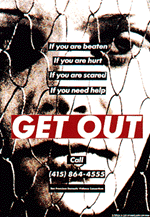
Barber Kruger’s subject matter is “blown-up, severely cropped photographs”  (Chadwick, 382).  She uses already existing photographs and accompanies them with meaningful texts that convey a message.  Many of the captions are rather deep and towards current struggles and causes.  Her signature texts were black letters against a red background.  A good example was in the piece titled: “Get Out.”  From my view, this piece tackles the idea of abuse.  It list examples, then tells the viewer to get out and even includes a number to call.  This in my opinion was a very powerful and meaningful piece.
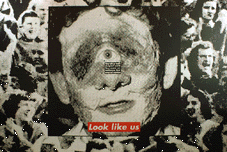
The medium Barber Kruger used again is photographs already in existence.  Most of the pictures were in black and white, but a few did differ such as the piece titled “Heard.”  I feel this medium successfully got Kruger’s point across to the viewer easier, yet in a more powerful way.  A lot of the images are very powerful, a good example is the piece titled “look like us.”  It has a woman centered in the midst of many other people.  The woman centered has only one eye and it looks like her face was sculpted.  Puzzling, yet intriguing, this piece was very compelling and definitely got her point across.  Barber Kruger’s earliest work dates back to 1969, but her peak was defiantly in the 80’s.  In the 1980’s, Carter, Reagan, and Bush senior were all presidents.  Major events during this time period include, the pope almost being assassinated, the first woman appointed to the U.S Supreme Court, famine in Ethiopia, and many other events.  A lot of these events were portrayed in Kruger’s work.

Barber Kruger’s work had a lot of significance which have left a lasting influence on contemporary artist.  According to Chadwick, “she emphasizes the ways in which language manipulated and undermines the assumption of masculine control over language and viewing” (382).  Barber Kruger was able to destabilize the women’s position as objects.  Like many other artist, I feel Kruger paved the way for other artist by taking risks that many others didn’t.  She didn’t continue to create art which continued the cycle of women as objects, but instead she exposed it.  Bringing it to light influenced upcoming artist to take risks and to not be confined to certain ideas when creating pieces.  Most of Kruger’s work dealt with feminism, classicism, consumerism, and individual autonomy and desire.  All of these were/are current issues in history.  Barber Kruger was a very influential female artist during the 20th century and in my opinion, of the best. Below are links showing more of Barber Kruger's work, ENJOY!!


                     - "I just say I'm an artist who works with pictures and words." - Barbara Kruger.

                                                     Work Cited
Chadwick, Whitney. Women, Art, and Society. 3rd Edition. United Kingdom: Thames and Hudson Ltd., 1990.

Twentieth Century: Society in the United States, Scholastic,  Myron, Marty, 2012  
http://www.scholastic.com/teachers/article/twentieth-century-society-united-states

The Art of Barber Kruger, 2003
http://www.barbarakruger.com/art.shtml

Barber Kruger: The Art History Archive, 
http://www.arthistoryarchive.com/arthistory/feminist/Barbara-Kruger.html

Thursday, November 15, 2012

Marina Abramović - The Artist is Present

Alejandro Hincapie

In April 2010, I was fortunate enough to participate in Marina Abramovic's performance art piece "The Artist in Present." Throughout the duration of her retrospective at the MoMA, she sat at the center of the museum's atrium everyday in silence for as long as the museum was open. Visitors were welcomed to sit in silence directly in front of her for as long as they could.

The museum streamed the performance live everyday via webcam on its website. My brother managed to capture several screenshots of my experience sitting with Abramovic.


The area in which Abramovic sat was squared off by a line on the floor. Museum visitors wishing to sit with her were instructed to wait in line outside the marked off area. When their turn to sit came, visitors were given further instructions by a museum security guard. 

1. Sit in silence
2. Look at Abramovic
3. Quietly walk out of the marked off area once done


I sat with Abramovic for 34 minutes before becoming unable to keep my concentration. 


Between every sitter, Abramovic took a moment to compose herself. 


The performance piece ran from March 14 to May 31, 2010. Abramovic sat for a total of 736 and a half hours. 


In 2012, a full-length documentary was released outlining her career and MoMA retrospective.


Monday, November 5, 2012

Group 8 Presentation - Frida Kahlo

Self Portrait with Monkey, 1934
Frida Kahlo was born on July 6, 1907 as Magdalena Carmen Frida Kahlo y Calderón in Mexico. Her father was of German descent, while her mother was Amerindian and of Spanish descent. 

Frida married a famous Mexican artist named Diego Rivera, who played a tremendous and significant role in her life as an artist. 

In 1925, she got into a trolley accident, resulting in a broken spinal column, a broken pelvis, and numerous amounts of other injuries. She could not have children because of all the fatal injuries that she sustained for the rest of her life after the accident.

During the 20th century, a movement of Surrealism began to grow amongst artists and writer who used fantastic images and incongruous juxtapositions in roder to represent unconscious thoughts and dreams. 

My Birth, 1932


  “Diego’s male painter friends didn’t take me so seriously, but there was a group of white males who did: those surrealists.  They believed their exploitation of dreams and the unconscious mind was universal, crossing all times and cultures. They claimed me as one of them.  Thank you, misters, but I am in my own world, not yours, I told them..”
  - The Guerrilla Girls   (“Frida Kahlo”)


My Nurse and I, 1937
My Nurse and I 
Frida had to get breastfed by a native Indian nurse as a child because her mother had already given birth to Frida’s sister, Cristina and was not able to feed them both. The painting depicts the relationship between Frida and her nurse. We see that there is no strong emotional bond between the two. It is rather distant and emotionless. We also see that Frida’s face is drawn as adult Frida rather than baby Frida. The reason was that adult Frida was having the memory so she drew her face as adult Frida. The nurse’s face is masked with a pre-Columbian funerary mask and the reason for that was Frida could not remember the features of her nurse and decided to cover it with the mask. This painting goes to show that she also missed out on the mother-daughter bond with her own mother.


The Two Fridas, 1939
Frida Kahlo's art was very personal.  As a mature artist she painted primarily self-portraits, surreal,  sensual images that depict the actual physical pain she endured life. She symbolized her circumstances in her art at a time when women were still undervalued. Her art has been said to be a symbol of female struggle and has enlightened a whole movement of female artists. She may be one of the first twentieth century fine artists to paint in detail about childbirth, miscarriages and other women's issues.

The Two Fridas
This painting is believed to be an expression of Friday's feelings at the time of her divorce. This double self-portrait was the first large-scale work that she painted. To your left is the unwanted Friday. And to your right, the wanted Friday.

The Broken Column, 1944
The Broken Column
This painting is one of Frida's most well-known and successful paintings. It was her way of saying and expressing how she must deal with the physical and emotional pain on her own as she lives on with her life. The nails represented the physical pain that she had endured since the accident. The larger nail piercing her heart respresents the emotional pain caused by Diego. 

Chadwick says (for Frida) that surrealism has "haunting complexity and narrative quality disturbing in its ambiguity". As demonstrated and proven in her work, Frida uses her own paintings to explore her own body and her consciousness of its vulnerability. She found more "liberated understand of sexuality that surrealism pursued". And Frida turns to her own sexual reality, using the experiences and pain (both emotional and physical) in her own life to fuel the passion for her art.