Monday, November 19, 2012

Georgia O'Keeffe


Georgia Totto O’Keeffe was an American artist who mostly painted large flowers presenting them as if seen through a magnifying lens and was part of the American Modernism Movement. She was born on November 15, 1887, in a farmhouse near Sun Prairie, Wisconsin as the second of seven children. At age ten she had already known that she would be an artist. Her and her sister took classes from Sara Mann, who was a local watercolorist.  O’Keeffe attended the Art Students League in New York City, where she won a scholarship to attend the League’s outdoor summer school. She won the scholarship for her oil painting Dead Rabbit with Copper Pot.

In 1908 O’Keeffe was working as a commercial artist in Chicago after relinquishing her career as an artist. Four years later she was introduced to the ideas of Arthur Wesley Dow in the University of Virginia, where she was motivated to paint again. At this time women didn’t have access to art training in America’s colleges and universities. Yet this is where she learned about expressing herself through her paintings. Dow believed that someone could use line, color, and shading harmoniously to express themselves.  From 1916 to 1918 O’Keeffe used the Palo Duro Canyon as a subject in her works while teaching in West Texas A&M University in Canyon.
Georgia O’Keeffe found her own style of painting around the mid-1920s. She added repetitive colors, forms, and themes in her works during the 1930s. “She liked to stress visual edges that have metaphysical implications: between night and day, earth and sky, life and death. She was not afraid of the large, symbolic reverberation; her bones often seem strangely alive, the flowers of the desert” (Georgia). She usually painted flowers and bones which let her violate certain boundaries.
Some of her most famous paintings are: Cow’s Skull: Red, White, and Blue and Cow’s Skull with Calico Roses. O’Keeffe began painting bones because of the majestic landscape of New Mexico. The desert bones helped her imagination but what brought everything together was scenery that was before her. “With its unusual geological formations, vivid colors, clarity of light, and exotic vegetation, that held her attention for more than four decades. Often she painted the rocks, cliffs, and mountains in dramatic close-up, just as she had done with her flower subjects” (O’Keeffe).
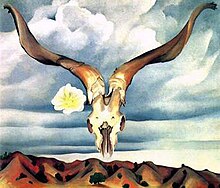
She showed a different side of art by painting natural beauty. “It was through these drawings that O'Keeffe came to the attention of the prominent photographer-turned-New York gallery owner Alfred Stieglitz in January 1916. After supposedly exclaiming, "At last, a woman on paper!" he exhibited her drawings at the 291 gallery, where the works of many avant-garde European and American artists and photographers were introduced to the American public” (O’Keeffe).  What O’Keeffe did revolutionized modern art in both her time and now. http://www.georgiaokeeffe.net/

 Works cited
Chadwick, Whitney. Women, Art, and Society. New York, NY: Thames and Hudson, 1990. Print.
"Georgia O'Keeffe Biography." Georgia O'Keeffe Biography. N.p., n.d. Web. 19 Nov. 2012. <http://www.lkwdpl.org/wihohio/okee-geo.htm>.
"Georgia O'Keeffe." Gegorgia O'Keeffe Paintings, Biography, and Quotes. N.p., n.d. Web. 19 Nov. 2012. <http://www.georgiaokeeffe.net/>.
"Heilbrunn Timeline of Art History." Georgia O'Keeffe (1887–1986). N.p., n.d. Web. 19 Nov. 2012. <http://www.metmuseum.org/toah/hd/geok/hd_geok.htm>.
The Guerrilla Girls' Bedside Companion to the History of Western Art. New York:                      Penguin, 1998. Print.


Yo Soy Frida Kahlo
By: Leslie Fernandez


Frida Kahlo, famous mexican painter, born in Coyoacan on July 6, 1907. She comes from a spanish and jewish background. Her father was a german jew and her mother was spanish and indigenous. Frida Kahlo focused most of her heritage towards her mother's culture. She loved the aspect of the spanish jewelry, clothes, and hairstyles. Regarding to who she was as a person, she was said to be a tremendous person, she says herself, " I always had a hot temper and said what was on my mind. I called a Porqueria a porqueria"(GG 78). Other than that, Frida Kahlo in my opinion is an amazing artist, her painting how so much meaning and life to them.

         Frida Kahlo went through a difficult journey in her lifetime, many of which stemmed from a traffic accident in her young years.Kahlo suffered lifelong health problems, many of which stemmed from a traffic accident in her teenage years. Due to the accident she was injured, resulting in a broken spinal column, broken pelvis, and other numerous of injuries. She had, " thirty-two operations in twenty- nine years and more miscarriages" (GG 78). She could not bare children due to these injuries. Not only did she suffer from injuries but she suffered with her love life with Diego Rivera, a man who played a tremendous role in her life as a lover and as an artist. These issues reflected to many of her paintings since paintings is what fulfilled her ambition. "Kahlo suggested, 'I paint myself because I am so often alone and because I am the subject I know best.'  She also stated, 'I was born a bitch. I was born a painter.' " (Kahlo 1). 


The Broken Column, 1944
       During her lifetime, she made at least 200 painting, drawings and sketches that related towards her experiences in life. For example, one of her famous works is , The Broken Column. This painting has so much significance to her physical and emotional pain she experience. The aspect of the column and nails signify the pain she went through and as for the larger nail on the left breast, it represents the emotional pain Diego put her through. This painting shows how broken and torn she is among her life experiences of physical and emotional pain. This comes to show how during the 20th century, the movement of surrealism began to grow amongst artist who used images to represent a dream or unconscious thought. Chadwick states how surrealism has, ""haunting complexity and narrative quality disturbing in its ambiguity"(289).


Another one of her painting is My Nurse and I . This painting tells a story about how she was breastfed by a native Indian nurse as a child. Her mother was not able to breast feed her or her sister. How you can tell there is no chemistry between the nurse or Frida, there is no relationship or emotions. It just a random native american breast feeding any child. If it were her mother the painting would have a whole different aspect rather than a distant relationship. This shows that Frida had no bond with her mother as a young child. Not only is the relationship off but even Frida Kahlo's face is painted has a mature adult instead of a baby face. Frida wanted the memory of how she remembered it and draw her face as an adult. As for the nurse she is masked with a pre-Columbian funerary mask because Frida could not depict the nurse's features and prefer to cover it. 


Two Fridas, 1939

"No one will ever know how much I love Diego... if I had health I would give it to him; if I had youth, he could have it all. I am not only his mother, I am the embryo, the seed, the first cell from whose potential he was engendered. I am he, beginning from the most primitive... ancient cells, which over time have become "feeling"
 Frida Kahlo painted many more that had significant meaning to them. Most into had to deal with pain, emotion, lost of childhood, and love life. It was very personal. She painted self-portraits, images that depicted her physical pain endured in her life. Especially painting like Two Fridas and My Birth. The painting of the Two Fridas is to say that its a double self portrait expressing her feeling about the divorce. The one on the left is her unwanted self and the right is her wanted self. It also shows how Frida Kahlo heart and blood flow on the right is normal and on the left is her how her blood stops and shows her pain because of the divorce. 

My Birth, 1932
                                                                      
  As for the painting of My Birth, it depicts how she has had miscarriages and not being able to bare a child of her own. As proven and shown in her work her painting explore her mind and body of it vulnerability. She uses her experiences of pain into her artwork. She was one of the first twentieth century artist was detail childbirth and women's issues. Frida Kahlo is an inspiration women, she is someone who stood in many battlefields and tried to find strength. She is what we call a symbol of female struggle and helps women know that they aren't alone. Frida Kahlo had passed away on July 13th, 1954.


Quote by Frida Kahlo

Nothing is more important than laughter." Laughing and letting go and feeling lighter give one strength. Tragedy is the most ridiculous thing "man" has, and I am sure that however much animals "suffer", they never exhibit their "pain" in open "theaters" or "behind doors". Their colors are truer than any image that any man may "represent" as painful.”


Citation


Chadwick, Whitney. Women, Art, and Society. New York, NY: Thames and Hudson, 1990. Print.


The Guerrilla Girls' Bedside Companion to the History of Western Art. New York: Penguin, 1998. Print.


Frida Kahlo, Biography, 2012

http://www.fridakahlo.com


Great Paintings by Basso, 2011

http://www.fridakahlo.org 

The Beauty in Pain


   Frida Kahlo twentieth century oil painting narrative artist. Her artwork takes us through the journey of her life and her pain. She went through so many obstacles in her life yet she never let her life altering events get the best of her, she took a negative and turned it into a positive. Her art work was her journal, her painting was her therapy, from her worst experiences came her best work. 

    Born Magdelena Carmen Frida Kahlo y Calderon, to a German Father and Amerindian and Spanish mother. Her style was influenced by her mothers culture she wore gaudy jewelry, and dresses and as stated  in Guerrilla Girls "..I played up my mother's heritage to the hilt: I wore peasant clothes, jewelry, and hairstyles."  It has been stated that initially, Frida was attending school to become a doctor she had no interest in becoming an artist. It was events that followed in her life which lead her to become interested in art. 
  Frida suffered a bad accident at the age of 18, in which she broke her spinal column, and her pelvis. Many were skeptical that she would live, and if she did, she would never be able to walk again or have children. After many months in recovery she did walk again, but was unable to have children.  The journey of her paintings began through her months in recovery. 
   Her first and many paintings were of herself,  by making herself the subject of the painting not only was she identifying with her heritage by the use of her garments and jewelry but she was also stating I am experiencing these obstacles. She was the art in her artwork.  She used her own female body in her paintings and paints her life.She painted a biography of all the experiences she went through in life.
  After she recovered she reached out to Diego Rivera which at the time was a mural painter, and an amazing one. She did everything in her power to get his attention and when she did he took her under his wing and eventually they have a crazy, unstable love story. "I seduced Diego when I was young and he was already a great painter." (GG,78)
Diego always thought highly of her work and knew she was extremely talented. However, when involved with Diego she was in his shadow. As stated in Guerrilla Girls " My husband Diego was treated like a god in his lifetime (I treated him like a god, too) but I was a martyr and was canonized only after I had suffered and died." (GG, 78) 
 During the times she was an artist many things were happening in Mexico, and she was very involved and it also is shown in her work.  As stated in the PBS article "She was a revolutionary artist born amidst political chaos in her homeland; born in the year of its own bloody rebirth, give or take a couple years. That image, according to the artist, is more truthful than fact itself. "
She was identified as a surrealist artist and though she denied the connection, her work does express it.  "During this period women artist were reinventing themselves as " beguiling personalities, poised uneasily between the worlds of artifice (art) and nature, or instinctual life." (Chadwicks, 313) 
http://www.frida-kahlo-foundation.org/263783/My-Birth-1932-large.jpg
In 1932, the above painting "My Birth" was drawn. This is depicting her own birth and is depicting her self coming out of the womb as an adult. This also addresses the fact that she herself has been unable to conceive. She drew her mothers face covered with the blanket to express that she had never been very close with her mother, unattached. The painting of the lady on the wall is called " Our Lady of Sorrow" which the lady is pierced by swords, and is bleeding and weeping expresses the sadness and pain in the image and the sadness Frida feels. 
http://www.learner.org/courses/globalart/assets/non_flash_386/work_057.jpg
 In 1944, Frida painted the above painting titled " The Broken Column" which relates to the broken spinal column she suffered from in her accident. The nails signify the pain she experiences, throughout  the years her pain still exist. The large nail by her heart signifies the pain she experiences from her love Diego.
   Frida Kahlo is one of my all time favorite painters. Her oil paintings speak volumes, and make such huge statements. She was so talented and through all her pain she kept it together enough to make such beautiful work. Her work surprises individuals on a daily basis. She was one individual that painted from her own experiences and her art work was her journal. Like writers have books, and memoirs, Frida had her paintings, truly amazing artist. She was an exceptional artist.


Below is my favorite clip from the movie Frida
I paint what I see the world outside, You Frida You paint from your heart  


References: 
 
Chadwick, Whitney. Women, Art, and Society. 3rd Edition. United Kingdom: Thames and Hudson Ltd., 1990.
Girls, Guerrilla. The Guerrilla Girls' Bedside Companion To The History of Western Art. England: Penguin Books., 1998  
 "The Life and Times of Frida Kahlo." PBS. PBS, 1 Mar. 2005. Web. 15 Nov. 2012. <http://www.pbs.org/weta/fridakahlo/life/index.html>.
  Voorhies, James. "Surrealism". In Heilbrunn Timeline of Art History. New York: The Metropolitan Museum of Art, 2000–. http://www.metmuseum.org/toah/hd/surr/hd_surr.htm (October 2004)
 "Frida Kahlo". Encyclopaedia Britannica. Encyclopædia Britannica Online.
Encyclopaedia Britannica Inc., 2012. Web. 15 Nov. 2012
<http://www.britannica.com/EBchecked/topic/309679/Frida-Kahlo/309679yblinks/Year-in-Review-Links>.