Thursday, September 20, 2012

The Male Gaze, Oppositional Gaze & Pop Culture

The “male gaze” is the observation of women from a one-sided, male point-of-view.  It establishes the dynamic of men as the spectators, and women as the objects of their gaze.  According to Merriam Webster Dictionary, to “gaze” means “to fix the eyes in a steady, intent look often with eagerness or studious attention”.  When I think of this definition, I think of an eager student studying his favorite subject.  He is studying that subject because he enjoys it, and he plans on using the subject to gain success in his future career.  The subject’s sole purpose is to be mastered by the student, so the student can use the subject to accomplish his goals.  The male gaze deems women as that favorite subject, whose purpose is to cater to men’s desires.  One could argue that a gaze is nothing more than an innocent, loving look from an admirer, but history defines it as being so much more.  Bell Hooks states that Emmet Till was murdered because his gaze at a white woman was interpreted “…as violation, as ‘rape’ of white womanhood…” (Hooks, 118).  The “male gaze” has so much power over a woman’s body, that it has been likened to the rape of a woman’s body.  The “male gaze” views a woman’s personality, aspirations, and opinions as non-existent; it reduces the sight of a woman to the sight of a thing; a thing that is up for grabs.


Up for grabs, get it?

The effects of the “male gaze” is everywhere around us.  Each day when I’m waiting for the bus, I see an ad for alcohol, where there’s a bikini-clad model standing next to the bottle.  It’s strange to me because her head is never shown; only her body from the neck-down is shown.  It could be that those parts of her are the only parts that matter to the assumedly male-viewer; if the male-viewer is reminded of her gross lady-brain, he might not buy the liquor!  From the ads on buses, television, billboards, magazines, and websites, the objectification of women is all-surrounding.  It has come to the point where majority of people are apathetic to it all, and accept this treatment of women as a permanent, static reality.

 The reason why the male gaze is so pervasive in popular culture is because it is the standard, popular, and normal point of view. Though we have come very far as a society, the rich, adult, white, heterosexual male still finds himself at the top of society’s hierarchy. Today, there are more female and non-white artists who enjoy great success and acclaim in their careers, but collectively they don’t have as strong of an impact that white male musicians, painters, architects, and sculptors have had on America’s identity.   It’s the byproduct of centuries of excluding other, non-white, non-male people from positions of considerable power and influence in art.  Because these “others” still have catching up to do, their works are viewed as alternative and pop culture/ art from a white male point of view is seen as mainstream.  And mainstream culture is the prevailing culture, the culture that is most profitable, and the culture that isn’t weird.  The male gaze in pop culture sees women as this “thing” that’s mainly here to sexually satisfy another person, to be used/consumed. So that is how women will be depicted in various ads.  If a woman gets offended by it, she is told to get a sense of humor or stop being weird, since the male gaze (and consequently the objectification of women) is pervasive and normal.
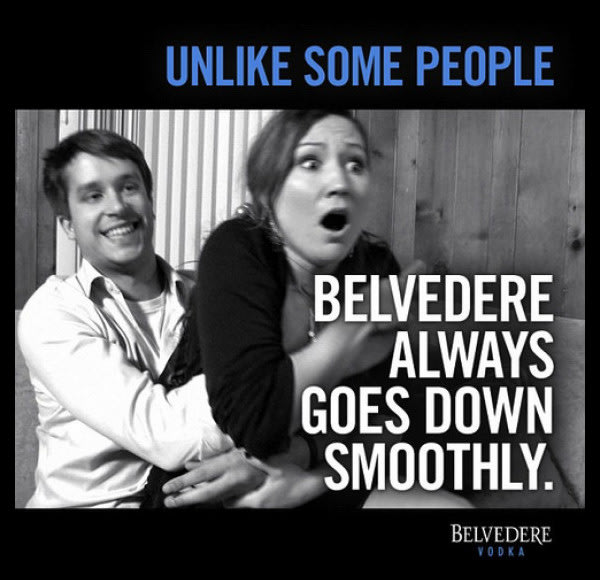
Apparently, she won't "go down" smoothly. LOLZ.

Rich, adult, white male blessing the object below with the sight of his genitals.
Woman's body literally being consumed.
This woman who is offended by the images, and actively criticizes them is seen as having the “oppositional gaze”.  According to Bell Hooks, black women are the ones most likely to have the oppositional gaze, because black women have the least in common with the women that are being celebrated and exposed in the media.  The images of vulnerable, passive, white women being dominated by men do not appeal to the one with the oppositional gaze.  That woman’s gaze is compared to “those hard intense direct looks children would give grown-ups, looks that were seen as confrontational, as gestures of resistance, challenges to authority” (Hooks, 115).  Just like a little child struggles to exert some control in his/her life, a black woman uses the oppositional gaze to defy and work against those misogynistic and racist structures in society that tell her that she’s unattractive, spiteful, and deserving of bad treatment and ultimately abandonment.  Hooks cites the character “Sapphire” in Amos ‘n’ Andy as evidence of how Hollywood liked to view black women as hateful and a burden to all.  According to the sexist way of thinking, women are only here to complement a man.  Therefore, white women complement the powerful image of a white man by appearing weak and docile.  Black women complement the threatening and brutish image of a black man by appearing even more threatening and insufferable themselves. Because black women have been placed at the least desirable, least privileged, and deepest bottom of society’s hierarchy, they have helped usher in feminism.  Hooks states, “Black female spectators, who refused to identify with white womanhood…created a critical space where the binary opposition Mulvey posits of ‘woman as image, man as bearer of the look’ was continually deconstructed.  As critical spectators, black women looked from a location that disrupted…” (Hooks, 123).  As those who had the oppositional gaze, black women spectators were the ones who helped shake the foundation that sexism and racism are based on.  By criticizing the cinema and consequently criticizing the status quo, they are asserting their presence and are demanding that a positive space in society be available to them.


Being a dark-skinned, African young woman, it’s very rare that I find a female image in popular culture and Art that I can immediately relate to.  As I matured, I can definitely say that I developed the oppositional gaze that Bell Hooks has discussed.  Growing up in the 3rd generation of hip-hop (mid-90’s, early 00’s), a large majority of the hip-hop music videos had the same visual: one or two rappers, surrounded by expensive liquor and a frenzy of gorgeous, light-skinned models in the club, in the streets, or on a boat.  Whenever there was a darker-skinned woman in a video, there was only one of her, she was usually a safe distance away from the viewer’s central focus. I absolutely cannot carve out my identity from what I see on television, because that would be very toxic (for any woman, really; but much more for an African woman).  I understand that various images of women in art and media celebrate white women as being the ultimate beauty, and that their beauty comes from their European features and their perceived traits of docility, availability, and submissiveness.  Historically, my identity has been to be the overly-aggressive, neck-rolling, finger-snapping, incessantly nagging antithesis of white womanhood.  Reading the Bell Hooks reading has provided me with some serious clarity.  It’s true that art and popular culture often seeks to ignore or paint a bad picture of women of color, and instead of ignoring it, I have to constantly critique it.  Through the way I carry myself and the opinions that I voice, I have to actively rebel against it, so that the socially progressive ball continues to roll upwards.
Works Cited

Hooks, Bell. In Black Looks; Race and Representation. Boston Massachusetts: South End Press

"Gaze".  Merriam Webster. 2012.


the male gaze and oppositional gaze


THE MALE GAZE
The male gaze can be defined a stereo typical way that males see women. As John Berger says, men look at women; women watch themselves being looked at. A woman always thinks about her appearance and how she appears to men. Since the early times women have considered men as the surveyor meaning that they watch women continually to understand them and realize how they should be treated. For example, Berger states, “If a woman throws a glass on the floor, this is an example of how she treats her own emotion of anger and so of how she would wish to be treated by others. If a man does the same, his action is only read as an expression of his anger” (Berger 47).
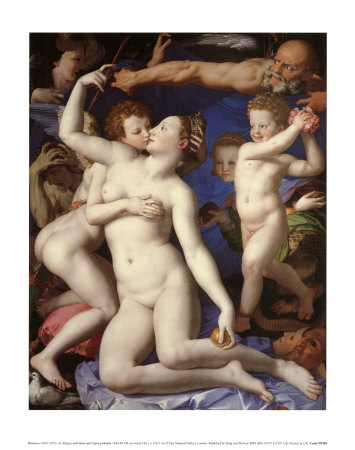
This picture is a perfect representation of how women contribute to the male gaze. “She is Venus. But the way her body is arranged has nothing to do with their kissing. Her body is arranged in the way it is, to display it to the man looking at the picture. This picture is made to appeal to his sexuality. It has nothing to do with her sexuality” (Berger 55). Women always think of themselves of how they want to appear to men, that is why in this painting, Venus’s body is at an angle so the viewer can see her nude.
The oppositional gaze on the other hand, is a way to passively criticize another culture or another person, it is used in this situation where African Americans where they didn’t have the ability to stand out. They did not have the ability to judge or the ability to act on their own emotions. It is a way to stereotype just like the male gaze is to stereotype females the oppositional gaze is a way to stereotype higher authority.
A person’s gaze can say much more than you may think. It can say whether the feel threatened by you, whether they want to show dominance, and many other things. As Bell Hooks states, “by courageously looking, we defiantly declared: ‘Not only will I stare. I want my look to change reality.’ Even in the worse circumstances of domination, the ability to manipulate one’s gaze in the face of structures of domination that would contain it. Opens up the possibility of agency” (Hooks 116). For example, in some scenarios, when a policeman or a body guard is approaching a suspect they give them a look and everyone knows that the body guard or policeman will take over the situation.
The male gaze and the oppositional gaze are two different things yet they have many things in common with one another. The male gaze is a way that males view females. “Men act. Women appear” (Berger). The oppositional gaze is a way that people can rebel against a higher authority so they feel in control.

Works cited
Hooks, Bell. In Black Looks; Race and Representation. Boston Massachusetts: South End Press, 1992.
Berger, John. Ways of Seeing. London, England, 1972
"Bodyguarding/PPO." Bodyguarding/PPO. N.p., n.d. Web. 20 Sept. 2012. <http://en.mj-tour.kiev.ua/index.php?page=1212>.
"Of Cabbages and Kings." Of Cabbages and Kings. N.p., n.d. Web. 20 Sept. 2012. <http://silverbells.wordpress.com/2008/09/23/venus-cupid-folly-and-time/>.

Wednesday, September 19, 2012

MALE GAZE AND OPPOSITIONAL GAZE

Looking has a great influence. Male gaze "is confrontational, authoritative and political. It is also dangerous because there is a certain power that when the male looks, he holds this power over a woman Bell Hooks (115). That is, the male gaze is the look that asserts his dominance and control over the woman. It is a strategy of domination males possess of females as an apparatus and mechanisms of control. It is a power system that does not give room for freedom (116). Bella Hook says "Women learn to have a rebellious and opposing gaze to look a certain way in order to resist the male gaze(116).
According to Bell Hooks, the oppositional gaze is a powerful look that challenges authority and serves as a powerful tool for colonized black people globally. Black women refer to the gaze as a form of resistance to the male gaze and its perception of the ideal image of woman. (116)
When most black people in the United States first had the opportunity to look at film and television, they did so fully aware that mass media was a system of knowledge and power reproducing and maintaining white supremacy. To stare at the television, or mainstream movies, to engage its images, was to engage its negation of black representation. It was the oppositional black gaze that responded to these looking relations by developing independent black cinema. Bell Hooks (117). As spectators, black men could repudiate the reproduction of racism in cinema and television, the negation of black presence even as they could feel as though they were rebelling against white supremacy by daring to look by engaging phallocentric politics of spectatorship. Given the real life public circumstances wherein black men were murdered/lynched for looking at white womanhood, where the black male gaze was always subject to control and /or punishment by the powerful white other, the private realm of television screens or dark theaters could unleash the represses gaze. Bell Hooks (118).
According to Bella Hooks, pg. 118, Major early black male independent filmmakers represented black women in their films as objects of male gaze. Even when representations of black women were present in film, our bodies and being were there to serve-to enhance and maintain white womanhood as object of the phallocentric gaze. Bell Hooks (119).
Men survey women before treating them. Consequently, how a woman appears to a man can determine how she will be treated. One might simplify this by saying: men act and women appear Men look at women, women watched themselves been looked at. This determines not only most relations between men and women but also the relation of women to themselves. The surveyor of woman in herself is male: the surveyed female. Thus she turns herself into an object and most particularly an object of vision: a sight. John Berger (46) (47).
With my work experience in Radio and TV broadcasting, I watch television and videos a lot of times, I now understand the production of the male gaze. Universally, our way of life is centered on presenting women as sexual objects whether it’s through billboards, music videos, magazines, or movies; women are the central source for drawing the audience. They are consistently being portrayed as objects of viewing pleasure. For instance, in most TV ad where cars or any other is advertised, women are used to sort of seduce the viewer to get full attention. Watch this image.Works Cited:
Hooks, Bell. In Black Looks; Race and Representation. Boston Massachusetts: South End Press, 1992.
Berger, John. Ways of Seeing. London, England, 1972


hey

Hey, my name is Debbie Maldonado and I am a freshman here ar Rutgers. I am majoring in criminal justice becasue law has always interested me and I really want to make a difference in the world. I am a forward on the Rutgers: Newark Women's Soccer Team and I love my team. The reason I took this class is because I really did not want to stay in my astronomy class, it was boring, so I decided to take this class mostly because my friend said that she was going to take it as well. Any way, it seems like an interesting class. I have a feeling that I am going to learn a lot. Art has always fascinated me and I am excited to learn about the histroy of it. Oh and I am really into music and music production so here is a link to a friend of mine who is starting off his career as a music producer, he is a big inspiration to me and an awesome musician: https://www.youtube.com/watch?v=Dqm1wTsJuB4&feature=relmfu

Tuesday, September 18, 2012

Middle Ages Presentation-Summary (Group 1)


Chapter 1: The Middle Ages
Group Members: Pritika Das, Wajiha Dawood, Tiffannie Diaz

Introduction/Religion as the Prevailing Force in the Middle Ages
The Middle Ages followed the fall of the Roman Empire and preceded the enlightenment of the Renaissance. It is important to understand the extent of power held by the church. The church controlled all aspects of life including religion, culture, and knowledge. It not only controlled what people could learn but who was allowed to learn. It was a time when people lived and worked in order to get into heaven. Church had a monopoly over salvation and so dictated the lives of the people. Since their lives revolved around the church so did the art that was produced. Today when thinking about art in the middle ages architecture dominates over illuminated texts and tapestries. Architecture which is considered an art made by man, over tapestries which is made by women.

Upper Class Women: The Nuns
There are two places during this time where women were allowed to produce art, the monasteries and the guilds. The nuns in the monastery represented the female intellect during this time and the majority of them came from noble families. In a time where most people did not know how to read this is a feat for women. But they lived with limitations on what they could do. Although they were allowed to learn they weren't allowed to give sermons or enter into priesthood. The work of women during this time was not attributed to their intellect instead they are made into mystics. Hildegard was listened to because she was writing a divine message. She is a vessel for a message but not the creator. The women in the guilds worked side by side men doing the same work yet there is a modern need to distinguish what is done by women and what was done by men. It is difficult to distinguish because so few artists put their names on their work during this time. 


One of the teachings by St. Paul
- "A woman must be a learner, listening quietly and with due submission. I do not permit a woman to be a teacher, nor must a women domineer over a man; she should be quiet." (Chadwick 45) 

Women's Artwork in the Middle Ages 
  • Bayeux Tapestry
-   Completed around1086 
-   Medieval embroidery: competed by the nunnery (there were no records of male embroiders)
-  "Actors" in these embroidered scenes were referred to as Military heroes
-   Consistent themes across the Tapestry: Loyalty, Bravery, Treachery, Power
-   Famous scene of Aelfgyva and the Cleric: Shows how women are excluded from power, by males


  • Hortes Deliciarum
- Completed by Herrad of Landsberg (after 1170)
- Documentation of the Nuns in her abbey
- Showcased the upper class (names of each nun was written in German and Latin)
- Philosophical influences by the old testament, gospels, acts & scenes from judgment day
- Subjects come from Byzantine and Western Art


Women's Depiction in Artwork 
-Lower class women were shown working
-Lack of power in the feudalistic system
-Nuns: Elite social class that was given some amount of power because they belonged to the clergy, but they were still inferior to men
-Women were portrayed  only in religious settings: conservative apparel was worn
-Societal structure and culture was reflected in the artwork 

Hildegard of Bingen
- 1098, Female German Composer, Writer and Philosopher
- Incomparable work
- Highlighted female qualities: strength and endurance 
- Parents enrolled their daughters in convents for artistic reasons and to escape "financial responsibility" (keeping the wealth in their family by not having to pay dowry)


Works of Hildegard
- 63 Hymns, 1 Miracle Play
- Her work embraced science and religion
- Kept her position in society, did not challenge the church and their opression of women

SCIVIAS


Hildegard's Influences 
- First medieval manuscript 
- Free thinking with feminine ideas
- Wrote about freeing the church from corruption
- Feminine religious movement 

Works Cited:
Chadwick, Whitney. Women, Art, and Society. 3rd ed. New York, NY: Thames and Hudson, 2002. Print.


Gazes and Their Reasoning


          To define the male gaze is not all that difficult, however the why, and how it is accomplished and how it has evolved is interesting at the very least. The first thing one must understand in the nature of human psychology, and how humans process information. The simple act of looking has connotations of challenging the unknown, and conquering it as understanding occurs, even if flawed. Animals use looks as well to assert themselves, and often physical confrontations are avoided, only using looks.

          So it is no surprise to see that man has developed similar practices regarding viewing, as a sign of dominance. However, as society evolved from a hunter mentality, to an agrarian culture, then later to feudalism and so on, this dominance was no longer backed on primal factors, such as strength, aggression, but rather status, wealth, position, all of which that do not have a primordial response associated with them. 

         In Chadwicks book “Women Art and Society” she poses that religion plays a key role in patriarchy (p 44). Religion and more the church, plays the role in instilling a new fear, one that transcends primordial fears, where physical strength, aggression become less important. This allows the gaze to no longer be backed by a certain risk of violence through confrontation.

        So now, as in the feudal era, we have power of the nobles over their subjects, and power of subjects over the women in their lives. These through religion become unquestioned, and more importantly unchallenged. 

           How do the pictures above affect you. You can sense an immediate response, and while looking at the young man in the photo, you may have fear, but you may also have doubts whether or not he may be successful in a direct confrontation. Now think that with the wolf. It may seem sily, but the idea is that the gaze is backed by the certainty of a response, including a violent one.

           As far as the oppositional gaze, it was a matter of time until the, at the time current male gaze, was challenged, even if under veil, since physical strength no longer became the dominant factor in conveying a message.  The Guerilla Girls mention in “Bedside Companion to the History of Western Art” (p25) how Hildegard Von Bingen started to “upset” the church, resulting in her ultimate confinement in house arrest for her ideas, conflicting with the church’s message of female subservience. 

          It may have been silenced at the time, but this and so many other messages eventually do make their way to their intended targets, regardless of how some groups try to prevent it, just to maintain a status quo of allowing them to be in control, veiling their lack of strength for a divine right look and own